Crystal Clear Communication for Impact

Why Clear Communication is a Strategic Business Advantage
Clarity in messaging is the practice of communicating your value proposition, product offering, or business purpose in a way that is instantly understandable to your target audience. For B2B companies buying professional video, it means a prospect can immediately see how your services support their marketing, sales, product, or leadership goals.
When people can quickly grasp what you do and why it matters, they can decide whether they need it, without confusion, friction, or guesswork. For DemoFlick, a Seattle based B2B video production company, this means clearly explaining how our Corporate Video Production, Explainer Video Production, and SaaS Product Demo Video services solve real communication challenges.
To achieve clarity in messaging:
- Know your audience and speak to their specific role, industry, and buyer stage
- Keep it simple by using plain language and avoiding internal or industry jargon
- Be consistent across your website, sales decks, and any corporate or explainer videos
- Lead with outcomes such as faster sales cycles, better product adoption, or aligned internal teams
- Test your message with real prospects and customers to validate that it is understood in seconds
Your website has about five seconds to make a first impression. In that brief window, visitors scan your headline, subheading, and visual cues to answer three critical questions: Can these people solve my problem? Do they work with companies like mine? What should I do next?
If your messaging does not answer these questions immediately, visitors start guessing. And confused customers do not buy. They leave.
The stakes are significant. Clear communication helps companies convert more qualified traffic, reduce time to value, and improve pipeline velocity. On the video side, clear scripts and structured narratives make it easier for decision makers to share your message internally and gain buy in.
Clarity is a strategic business advantage. When people instantly understand what you do, sales calls become smoother, marketing campaigns perform better, and referrals become easier. For example, a concise corporate overview video on your homepage can reduce cognitive load, answer stakeholder questions in advance, and build trust from the first interaction.
Despite its obvious importance, many B2B organizations still use sophisticated language, internal acronyms, or clever wordplay to sound premium. This is selfish messaging. It makes you feel smart while making your customers work harder. For complex B2B offerings, especially in SaaS, clarity beats cleverness every single time because multiple internal stakeholders must quickly align around the same story.
The High Cost of Confusion: Why Clarity in Messaging is Non-Negotiable
Poor messaging costs your company money and erodes your brand. When your message is overly complex, it will not be understood the way you hope, and it certainly will not be remembered. For B2B teams buying video production, unclear messaging slows internal approvals, weakens campaigns, and makes it harder to justify budget.
Contradictory, unclear communications make it much more difficult to differentiate your offering, sell your products, and make your case in crowded categories. If your messaging does not answer key questions immediately, visitors begin to guess, and confused customers do not buy. They simply leave and evaluate another vendor.
The Financial Impact of Unclear Communication
Unclear communication leads to costly mistakes, misinterpretations, and misunderstandings. When sales, marketing, and product teams are not aligned on the same story, inaccurate messaging spreads and productivity suffers. Video projects take longer, revisions increase, and campaigns launch with mixed messages.
Research from sources such as McKinsey and Forrester has consistently shown that companies that communicate clearly and consistently across channels grow faster and convert more efficiently than those that do not. Clear messaging improves funnel performance, from ad click to video view to sales conversation.
For example, in one engagement, simplifying a complex product story into a direct, outcome focused homepage video helped a B2B SaaS client double qualified demo requests without increasing media spend. This type of result comes from clarity, not from more aggressive persuasion tactics.
At DemoFlick, we help B2B organizations avoid these pitfalls by crafting clear, structured narratives through Corporate Video Production, Explainer Video Production, and SaaS Product Demo Videos that are built to support specific business goals.
How Ambiguity Erodes Brand Trust and Credibility
In today’s crowded marketplace, building and maintaining trust is paramount for revenue leaders and CMOs. Inconsistent messaging confuses prospective buyers and reduces conversion rates at every stage of the journey.
If you do not steer how people think about your product, the market will create its own version. That version may not match your vision or your pricing. Misaligned narratives are especially risky when multiple decision makers, such as IT, finance, and business leaders, must agree on the same purchase.
Contradictory messages, whether internal or external, erode brand trust and credibility. When your audience receives conflicting information, it creates doubt and makes it challenging for them to form a reliable image of your brand.
A strong brand identity requires consistent messaging that aligns across all touchpoints, including your website, sales presentations, trade show videos, and internal communications. Without this, damaged relationships and a fragmented brand identity are likely.
Our Corporate Video Production services are designed to help you craft a clear company overview or brand story video that becomes the single source of truth for how you describe your business. This is especially valuable when you need to align leadership, sales, partners, and new hires around the same narrative.
The Core Principles of Clear Communication
Achieving clarity in messaging is not an accident. It is a deliberate choice guided by core principles. These principles help ensure your message is not only heard but also understood, remembered, and used by your internal and external stakeholders.

The 3 C’s: Being Clear, Concise, and Consistent
At the heart of effective communication are the “3 C’s”: Clear, Concise, and Consistent. For B2B buyers evaluating video partners, these principles are what separate strategic content from generic creative.
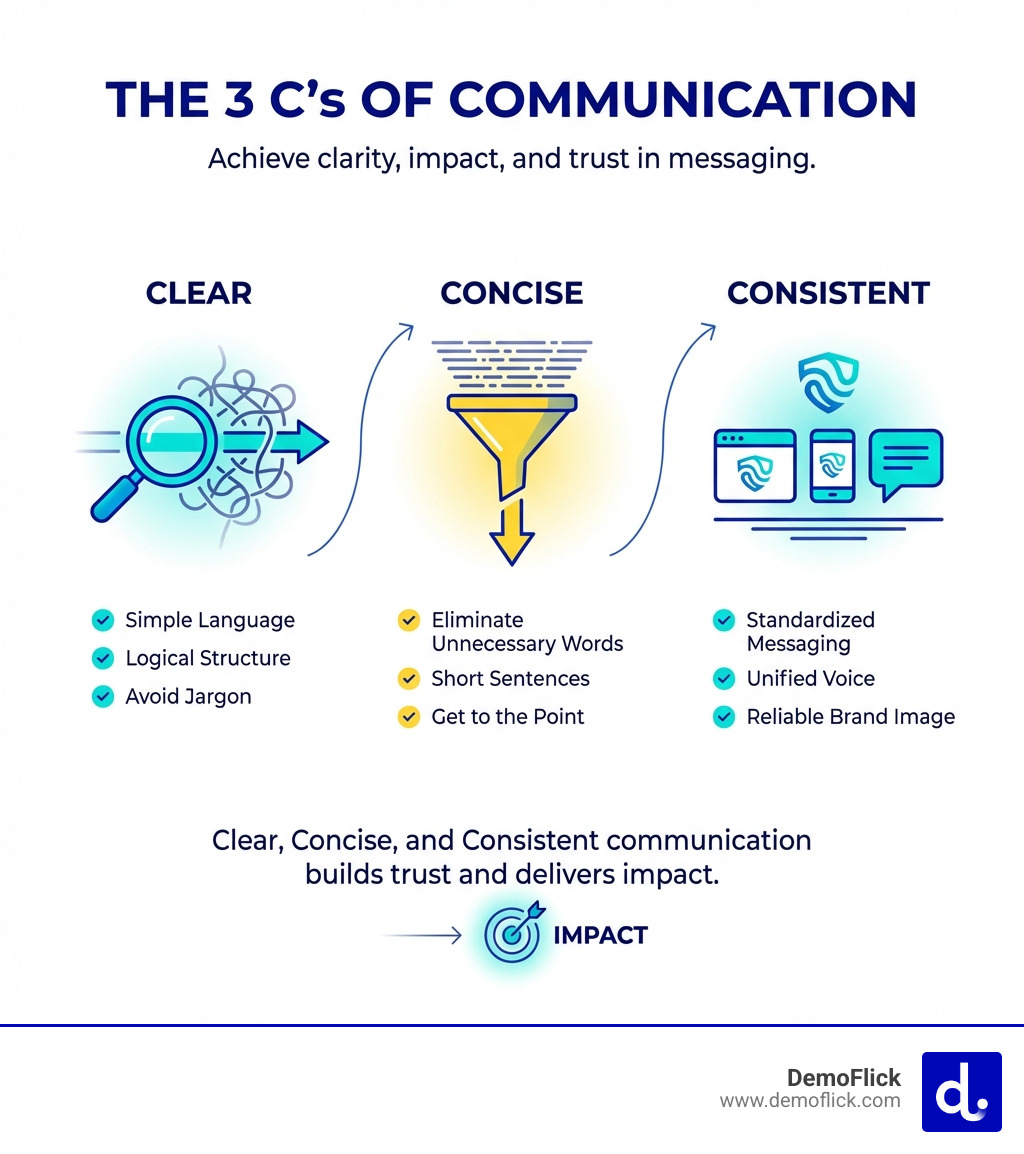
- Clear: Your message should be easy to understand without confusion or misinterpretation. This means using straightforward language and logical structure. Avoid confusing acronyms and internal language that might alienate your audience. For example, our Animated Explainer Videos are crafted to make complex topics simple enough to share with non technical stakeholders.
- Concise: Get straight to the point. Eliminate unnecessary words and repetition. Keep sentences and scenes focused on a single idea. In video, this means tight scripting and strong visual structure so viewers understand the core value in the first 30 to 60 seconds.
- Consistent: Maintain a reliable flow of information across all channels and over time. Consistent messaging builds a stable image in the minds of your audience, which increases trust and speeds up internal decision making. This includes a consistent style and tone across your corporate, explainer, and product demo videos.
Implementing these C’s involves practical steps like aligning sales and marketing on core messaging, structuring video scripts logically, and developing a communication style guide. When we work with clients on projects like How Can Animated Explainer Videos Enhance Your Corporate Communication Strategy?, these principles are at the forefront of our approach.
The Audience First Approach to Achieving Clarity in Messaging
Understanding your audience is the cornerstone of effective B2B communication. Without knowing who you are speaking to, it is impossible to tailor your message to their role, priorities, and pressure points.
For example, a CMO may care most about pipeline, brand perception, and campaign performance. A product leader may focus on adoption, feature understanding, and support volume. A founder may care about investor confidence and company narrative.
An audience first approach requires empathy and structured discovery. When crafting messages, ask: What does my audience already know? What do they need to know to move to the next stage? What risk or opportunity is top of mind for them right now?
By linking your message to what the audience cares about, you make it immediately relevant. This approach ensures your messaging resonates and makes an instant connection. When crafting Lights, Camera, Action: Crafting Compelling User Journey Videos, we focus on the user’s perspective and the buyer’s decision flow to ensure maximum impact.
Why Clarity Always Wins Over Cleverness
There is a common trap in business communication, especially in branding and creative work. Teams try to be clever instead of clear. Clever messaging may sound sophisticated or witty, but it often makes customers work harder to understand your value.
Clarity, on the other hand, is customer centric and business focused. It respects your audience’s time and cognitive load. When people instantly understand what you do and who you serve, they can quickly decide if they should bring your solution into an internal conversation.
For B2B video, clarity means a stakeholder can forward your corporate overview or product demo video to a colleague and say, “Watch this, it explains our options better than I can.” That is the signal your messaging is working.
Clear messaging eliminates guesswork and transforms every aspect of communication, from sales calls to board presentations and partner briefings. It focuses on outcomes, not just features, so your audience quickly grasps the problem you solve, the value you provide, and why now is the right time to act.
Building a Framework for Lasting Clarity in Messaging
To ensure clarity in messaging is not just an aspiration but a consistent reality, organizations need a structured approach. This is where a messaging framework comes into play, acting as the backbone of all your communication efforts, including your video content strategy.
Key Components of a Messaging Hierarchy
A messaging hierarchy organizes your brand’s core messages in a structured way, ensuring consistency and clarity across all communication. Think of it as a ladder that guides how you talk about your business, from broad ideas down to specific proof points.
Key components typically include:
- Vision and Mission: These foundational statements articulate your company’s ultimate aspiration and purpose. They guide daily actions and set the tone for your corporate story and leadership messaging.
- Positioning Statement: This defines who your brand is for, what problem it solves, and what makes it different. It should drive how you brief any Corporate Video Production or strategic explainer project.
- Key Differentiators: These are the unique aspects of your product or service that provide a clear advantage. They should appear clearly and consistently across your sales collateral and video content.
- Value Proposition: This explains how your product or service solves your customer’s problems and delivers measurable benefits. For video, this often becomes your opening narrative and call to action.
- Supporting Messages: These elaborate on your value proposition and differentiators, providing more detail about use cases, features, and outcomes.
- Proof Points: These are the evidence, data, testimonials, or case examples that back up your claims and build credibility. They are powerful when integrated into customer story videos or SaaS product demos.
- Tone of Voice: This defines your brand’s personality and how it communicates. It ensures a consistent emotional connection across your website, presentations, and video scripts.
Implementing a messaging hierarchy helps align internal teams and external communications for clarity. It ensures that everyone, from the CEO to the customer success team, speaks with a unified voice. Our Corporate Video Production services help B2B companies translate these components into compelling, structured narratives that can be reused across channels.
Practical Techniques for Crafting Memorable Messages
Crafting memorable messages goes beyond simply conveying information. It involves making that information easy to recall, share, and act on.
- Storytelling: Decision makers rely on stories to explain change and justify investment. Storytelling lets you connect your product to a real business situation, which is ideal for corporate overview and customer case study videos.
- Emotional Appeal: Connect with your audience’s aspirations, fears, or pressures, such as missed targets, churn, or transformation deadlines. Lead with what your audience cares about, then show how your solution helps.
- Strong Verbs and Short Sentences: Use active voice and powerful verbs to make your language more dynamic and concise. In scripts, short, punchy lines are easier for viewers to follow and remember.
- The “One Simple Thing” Concept: Boil your complex offering down to a single, compelling idea. If your audience cannot repeat this one thing after watching your video, they are unlikely to champion you internally.
When we create Bring Your Message to Life: Crafting Engaging Character Explainer Videos, we use these techniques to ensure the message is clear, relevant to business outcomes, and memorable across stakeholder groups.
How a Framework Aligns Your Entire Organization
A well defined messaging framework acts as a central playbook for your entire organization. It ensures that everyone, from marketing and sales to product development and customer support, is aligned on the same story.
- Unified Voice: A framework provides a consistent brand voice and narrative across all channels. This eliminates contradictory communications and strengthens your brand identity.
- Consistent External Communications: Whether it is a website, social media, sales pitch, or product demo video, the framework ensures all external communications reflect the same core messages and value proposition.
- Internal Team Alignment: It fosters internal clarity, helping employees understand the company’s vision, goals, and how their work contributes. This reduces misunderstandings and boosts productivity.
- Sales Enablement: Sales teams can more effectively articulate the value proposition when they have clear, consistent messaging and video assets to draw from. This makes sales calls smoother and improves conversion rates.
A messaging framework helps you avoid the scenario where everyone is not “on the same page,” which leads to inaccurate messaging and productivity loss. For complex B2B offerings, especially in SaaS, this alignment is critical. Our Demystifying Demos: Crafting Engaging Software Explainer Videos are often built on such frameworks to ensure internal and external consistency.
How Leaders Use Clear Communication to Drive Strategy and Vision
Leaders are pivotal in devising strategies that help their organizations succeed. However, their vision and strategies only become reality if they are communicated with clarity in messaging to their teams, investors, and the market. Clear leadership communication minimizes misunderstandings, increases collaboration, and boosts engagement.
For B2B executives, a clear narrative is also a growth asset. It shapes how new markets understand you, how recruiters pitch you, and how your team tells your story in every meeting and presentation.
Structuring Your Message for Maximum Comprehension
Leaders can ensure maximum comprehension by organizing their ideas in a logical structure. The “What, So What, Now What” framework is an effective tool for this:
- What: Describe the situation or the core message. What is changing, what is the new strategy, or what problem are you tackling?
- So What: Explain the implications and relevance for your audience. Why does this matter for revenue, product roadmap, customer experience, or internal efficiency?
- Now What: Provide a clear call to action or next steps. What must teams start, stop, or continue doing, and by when?
Using this framework, along with other best practices, helps create messages that are understood and actionable. It is also a strong foundation for leadership videos and town hall content that need to be watched and shared across distributed teams.
Additionally, using visual aids like charts, videos, and images can significantly increase audience understanding. Video is especially effective for complex strategy rollouts, product launches, or cultural initiatives, because it combines message, tone, and visual context in one format.
Encouraging feedback and questions also supports two way communication, allowing leaders to assess message clarity and address any doubts. Our Explainer Video Production services help leaders turn complex information into clear, visually engaging content that can be reused across meetings and channels.
The Leader’s Role in Championing a Culture of Clarity
A leader’s commitment to clarity in messaging sets the standard for the entire organization. By championing a culture of clarity, leaders create an environment where effective communication is expected and supported.
This involves:
- Setting Expectations: Clearly defining what effective communication looks like in your organization and how it supports growth.
- Leading by Example: Demonstrating clear, concise, and consistent communication in every presentation, all hands, and external appearance.
- Fostering Two Way Communication: Creating channels for feedback, encouraging active listening, and making sure employees feel heard and informed.
- Empowering Employees: Providing tools and training, including video resources and message guides, so employees can communicate clearly with customers and partners.
When leaders prioritize clear communication, they empower employees to understand expectations, tackle tasks confidently, and contribute more effectively. This leads to greater productivity, improved job satisfaction, and a more resilient organization.
For B2B companies that want to support this with video, we often recommend a combination of a clear corporate overview, role specific explainers, and SaaS product demos. You can learn more about how we approach this in Why Your Business Needs Animated Explainer Videos and How to Get Them.
Frequently Asked Questions about Clarity in Messaging
How do we know if our messaging is unclear to our B2B audience?
Look for signs such as low quality leads, prospects asking basic questions late in the sales process, misaligned internal descriptions of your product, or videos that generate views but not next steps. A simple test is to ask a stakeholder to explain your offer after a 60 second video. If they struggle, your message is not clear enough.
How does clarity in messaging improve the ROI of corporate and explainer videos?
Clear messaging ensures every second of video reinforces the same story and business outcome. This increases engagement, makes it easier for viewers to share the content internally, and reduces the need for additional explanation from sales. As a result, video assets stay relevant longer and support more opportunities across the funnel.
Can our messaging be too simple for a technical or enterprise product?
Clarity is not about removing depth. It is about sequencing information. The top of your message should focus on the problem, audience, and outcome in plain language. You can layer technical details and architecture later in the buyer journey, through product demo videos, documentation, or technical deep dives.
How should we use video to align internal teams on a new narrative or positioning?
Start by building a concise messaging framework, then create a corporate overview or leadership video that explains the what, so what, and now what of your new positioning. Use this video in sales kickoffs, onboarding, and internal meetings so everyone hears the same story and can repeat it confidently.
When is the right time to bring in a video production partner to clarify our messaging?
Bring in a strategic video partner once you have a draft narrative and clear business goals, but before you have committed to final copy or assets. A partner like DemoFlick can help refine your message for video, stress test your structure, and design visuals that support clarity for buyers and internal stakeholders.
Conclusion
In the dynamic B2B landscape, clarity in messaging is not merely a communication preference; it is a strategic imperative. We’ve explored how a lack of clarity can lead to significant financial costs, erode brand trust, and hinder organizational alignment. Conversely, by embracing the core principles of clear, concise, and consistent communication, and by building robust messaging frameworks, businesses can open up higher revenues, boost brand value, and foster deeper connections with their audience.
For leaders, championing a culture of clarity means effectively communicating vision and strategy, empowering teams, and driving organizational success. It’s about making sure that every message resonates, is remembered, and compels action.
At DemoFlick, we understand that complex ideas require clear communication. We specialize in changing intricate B2B products, services, and workflows into compelling video narratives that reduce friction, improve understanding, and drive specific business outcomes. If your organization is ready to move beyond confusion and accept the power of crystal clear communication, we’re here to help.
Ready to make your message impossible to misunderstand? Get a Quote from DemoFlick today.
