Lights, Camera, Action! Crafting Compelling User Journey Videos

Why User Journey Videos Matter for B2B Communication
A user journey video walks viewers through the experience a real customer has with your product or service, from first problem to measurable business outcome. For B2B teams, this format is especially effective when it reflects actual workflows, buying committees, and post sale adoption.
At DemoFlick, a Seattle based B2B video production company, we use user journey videos to connect our core corporate video production, explainer video production, and SaaS product demo video capabilities into one coherent story that aligns with your sales and customer success motions.
Unlike product demos that focus on features, or standalone explainer videos that introduce concepts, user journey videos tell a complete narrative. They show the challenges your buyers face, how they discover your solution, how implementation works, and the outcomes that matter to executives and operators.
How to create an effective user journey video for B2B buyers:
- Map content to journey stages: Awareness, consideration, decision, and retention each require different video types and different levels of detail.
- Choose a relatable protagonist: Profile a real customer or role, such as a VP of Marketing or Head of Product, who represents your target account and has achieved results.
- Balance product integration: Tie your solution naturally into the story without turning the video into a feature tour.
- Keep it concise and focused: For most B2B use cases, user journey videos are most effective in the 90 second to 3 minute range, depending on deal size and complexity.
- Distribute strategically across revenue teams: Place videos on core website pages, in outbound and nurture campaigns, within sales presentations, and in customer success playbooks.
When many organizations hear the term “buyer journey,” they picture a linear marketing funnel. In reality, enterprise buying cycles are messy, involve multiple decision makers, and extend into onboarding and renewal.
The practical issue is simple: one video rarely serves all stakeholders at all touchpoints. A prospect encountering your brand for the first time needs a high level story. A technical evaluator needs depth. A champion building an internal business case needs proof and clarity.
Video content gives you a flexible way to address these different needs. Research from Wyzowl and HubSpot shows that B2B buyers consistently prefer video when evaluating vendors, especially for complex products.
For DemoFlick clients, a well planned user journey video typically supports at least one of these outcomes:
- Improves the performance of a core corporate video on your homepage or product overview page.
- Equips marketing, sales, and customer success with a shared narrative they can reuse in campaigns and meetings.
- Demonstrates how your solution removes friction in real B2B processes, such as onboarding, reporting, or compliance.
- Supports lead generation by increasing engagement, time on page, and conversion on key landing pages.
User journey videos often blend elements of customer testimonial, lifestyle narrative, and corporate story. They work well on your website, in account based marketing sequences, inside sales decks, and in post sale enablement.
This guide walks through how to create user journey videos that improve product adoption, reduce churn, and build stronger customer relationships across your entire B2B marketing and revenue engine.
A user journey video is a strategic corporate communication asset that visualizes the entire experience a user has with a product or service. It starts with initial problem recognition and extends through evaluation, implementation, and ongoing value.
For B2B organizations, these videos are not entertainment content. They are built to reduce confusion in complex sales cycles, align internal stakeholders, and drive specific next steps such as scheduling a demo, aligning with procurement, or expanding usage.
By illustrating the customer lifecycle and clearly showing what success looks like, user journey videos can significantly boost product adoption and reduce churn. For many DemoFlick clients, they sit alongside corporate overview videos, explainer videos, and SaaS product demos as one of the most referenced assets in both sales and customer success conversations.
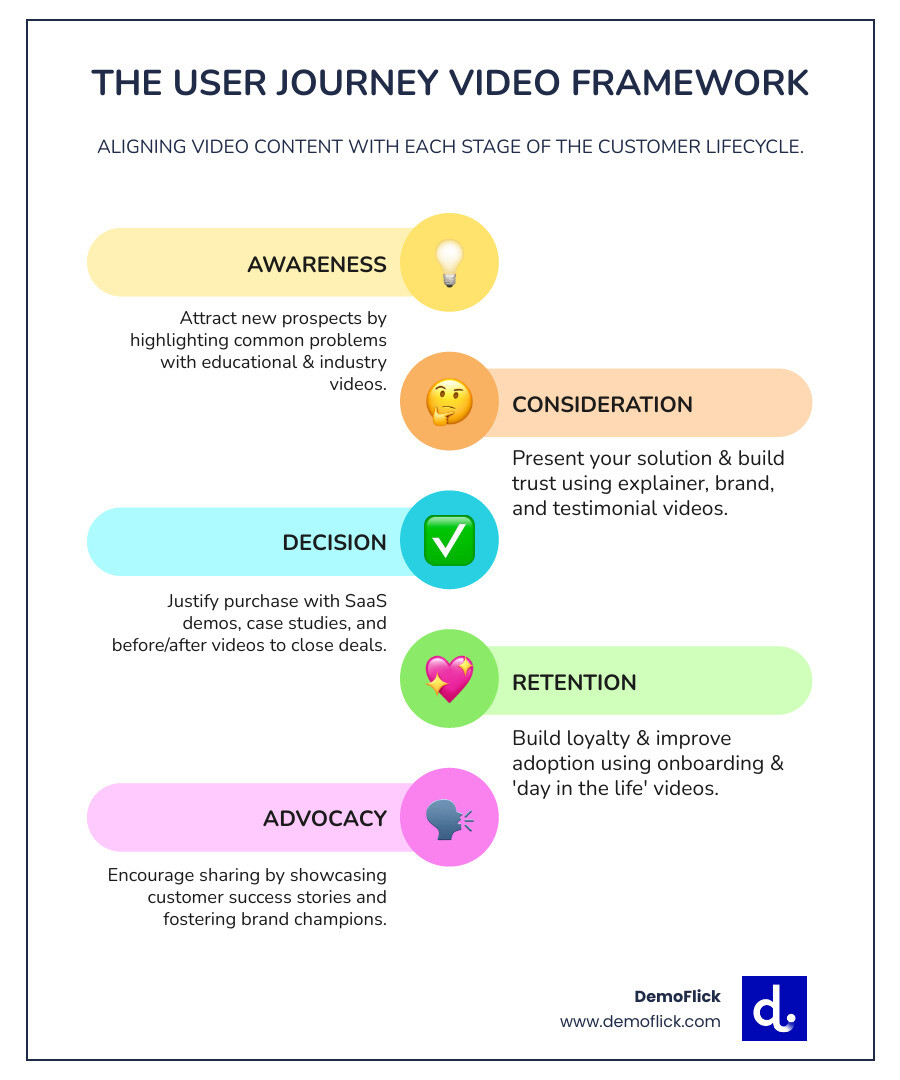
Mapping Video Content to the User Journey Stages
Understanding the different stages of a B2B user’s journey is crucial for creating effective video content that serves marketing, sales, and customer success teams. When we plan a user journey video at DemoFlick, we treat it as a structured narrative that supports revenue, not just a creative project.
Awareness: Highlighting the Problem for B2B Stakeholders
At the awareness stage, potential customers are recognizing a business problem or operational risk. They are not yet comparing vendors. They want clarity.
This is where your user journey video can highlight the challenges a specific persona faces, such as a CMO struggling with fragmented messaging or a CTO dealing with inefficient processes.
Industry overview videos can illustrate broader opportunities or pain points within a sector. Educational content, such as high level “how it works” or trend explainers, helps buyers name their problem.
These videos attract new visitors by providing value without heavy promotion, while still positioning your company as a credible partner. For planning, it helps to understand the fundamentals of customer journey mapping. Learn more from Nielsen Norman Group: What is customer journey mapping?.
Consideration: Presenting Your Solution with Clarity
Once prospects understand their problem, they enter the consideration stage. They are actively researching potential solutions and building a shortlist.
Here, your user journey video should clearly present how your offering fits into their existing environment, their processes, and their success metrics.
Explainer videos work well to simplify complex products or services into clear, memorable explanations. Corporate brand videos can provide context about your mission, track record, and differentiation.
Testimonial driven segments, where real customers speak to implementation, support, and measurable results, build trust fast. For B2B companies with complex offerings, a well crafted explainer video can clarify your value proposition and educate multiple stakeholders at once. See more about DemoFlick’s explainer video production services.
Decision: Closing the Deal with Proof and Specifics
In the decision stage, your prospect is close to a purchase. They may be aligning internal stakeholders, confirming integration details, and finalizing budget.
Your user journey video content here should provide clear proof and practical detail. Decision makers want to see how your product behaves in real workflows, how onboarding is handled, and what outcomes have been achieved for similar organizations.
SaaS product demos are essential for technology solutions. They guide viewers through authentic use cases and real data scenarios. Case study videos can show how a client moved from a specific starting point to a quantified result.
“Before and after” segments help illustrate change in a way that non technical executives understand quickly. At DemoFlick, we specialize in narrative driven SaaS product demos that reduce onboarding friction and accelerate internal buy in. See how SaaS product demo videos work.
Retention and Advocacy: Building Loyalty and Expansion
The journey does not end with a signed contract. For B2B organizations, renewals and expansions often represent the majority of customer lifetime value.
In the retention and advocacy stages, user journey videos shift from acquisition to support, enablement, and community building.
Onboarding videos ensure new customers get started smoothly and understand how to achieve value in the first 30 to 90 days. “Day in the life” videos that show real users integrating your solution into daily workflows can improve adoption.
Customer success stories reinforce the original decision and highlight additional use cases, which is helpful for expansion conversations.
Here are 3 ways to use video for customer retention and expansion:
- Onboarding and tutorial videos: Guide new users through initial setup and key flows, reduce support tickets, and build confidence.
- “Day in the life” videos: Showcase how teams use your product in context, reinforcing best practices and adoption.
- Customer success stories: Highlight long term benefits and strategic impact, such as improved reporting, reduced risk, or faster time to value.
How to Create a Strategic User Journey Video
Crafting a powerful user journey video for B2B audiences requires strategic planning, clear storytelling, and alignment with sales and customer success goals. At DemoFlick, we approach these projects as corporate communication tools designed to move deals forward and make adoption easier.
Step 1: Define Your Goal and Audience
Before production, you need a clear understanding of why you are creating this video and who needs to watch it.
Start by defining specific business objectives. Examples include improving conversion on a key landing page, shortening sales cycles, supporting a new product launch, or reducing onboarding time.
Then, clarify your audience segments. For B2B, that often means different roles such as C level executives, functional leaders, and technical evaluators. Each has distinct concerns, from risk and ROI to usability and integration.
This foundational work ensures your user journey video speaks directly to their needs and reflects their reality. A strong understanding of your customer’s journey is the bedrock of effective video content. Explore The 5 Steps to Customer Journey Mapping from Nielsen Norman Group to get started.
Step 2: Craft a Compelling Narrative
With your goals and audience defined, you can build the story. Every strategic user journey video needs a clear narrative arc that business viewers can follow in one pass.
Select a protagonist who mirrors your ideal customer and role. For example, a Director of Operations in manufacturing or a VP of Customer Success in a SaaS company.
Show their starting point, the friction they face, how they discover and evaluate your solution, and what happens after implementation. Be specific about metrics that matter, such as time saved, error reduction, or revenue impact.
Scripting is critical. It provides the structure, phrasing, and calls to action that guide your audience. At DemoFlick, our corporate video production process emphasizes discovery and upfront scripting, so internal teams do not have to rewrite the story later. Learn about our video production process.
Step 3: Plan Your Production

Once your narrative is approved, meticulous planning keeps production on time, on budget, and aligned with stakeholders.
Create a detailed shot list that maps directly to the script. Identify which scenes must feature real people, product screens, workplace environments, or motion graphics.
Plan b roll that reinforces the story, such as teams collaborating in an office, product usage in a warehouse, or executives presenting results.
If you include interviews, prepare clear prompts that elicit concise, credible answers. Logistics such as location, schedule, and approvals should be organized early, especially when filming with customers.
During editing, consider pacing, captions, and graphic overlays. These elements help busy decision makers absorb the message quickly, even with sound off.
Step 4: Essential Components of a Compelling User Journey Video
What makes a user journey video stand out in a B2B setting is not just visuals. It is the combination of authenticity, structure, and relevance.
Key components include:
- Authenticity: Realistic scenarios, language that your customers actually use, and believable results.
- Relatable protagonist: A role and context that your target accounts recognize.
- Clear product role: Your solution should feel like a natural part of the story, integrated into workflows rather than framed as a generic advertisement.
- Professional production quality: Clean audio, intentional framing, and thoughtful editing that reflect well on your brand.
- Emotional and rational connection: Viewers should feel the initial pain, see the path to resolution, and understand the business impact in concrete terms.
When these elements are present, user journey videos can sit at the center of your corporate video strategy, supporting demand generation, sales enablement, and customer success.
Distributing and Measuring Your Video’s Impact
Creating a strong user journey video is only half the work. To drive real business value, you need a thoughtful distribution plan and clear measurement. This ensures the video supports your marketing, sales, and customer success teams in a measurable way.
Best Practices for Video Distribution
Think carefully about where and how your user journey video will be used.
On your website, consider placement on your homepage, core solution pages, pricing pages, and a dedicated customer stories or case study section. Make sure the video supports the primary call to action on that page.
Email campaigns can deliver the video to specific segments, such as new leads, open opportunities, or newly onboarded customers. In account based marketing, these videos can be tailored to industries or verticals.
Sales teams can embed user journey videos directly in presentations, proposals, and follow up messages. This is especially useful for large buying committees that cannot attend a single live demo.
On social platforms such as LinkedIn and YouTube, shorter cuts of the video can drive traffic back to core assets. Paid promotion can help you reach high value accounts and roles more consistently.
Measuring the Effectiveness of Your User Journey Video
| Metric | Definition | Why it Matters |
|---|---|---|
| View Through Rate | The percentage of viewers who watch a significant portion or all of your video. | Indicates how engaging your content is. Higher rates suggest a compelling story and good pacing. |
| Click Through Rate | The percentage of viewers who click on a call to action within or after your video. | Measures how effectively your video drives actions, such as visiting a product page or requesting a corporate demo. |
| Conversion Rate | The percentage of viewers who complete a specific goal after watching your video. | Links video performance to outcomes such as demo requests, trial signups, or contact form submissions. |
| Engagement Rate | Measures interactions like likes, comments, shares, and watch time. | Shows how much your audience resonates with the content and whether it strengthens social proof and reach. |
| Customer Feedback | Direct qualitative insights from surveys, interviews, or comments about the video’s impact. | Provides context to quantitative data, revealing whether the story is clear, credible, and aligned with real needs. |
| ROI Calculation | Comparison of production and distribution cost against the revenue or savings generated. | Helps justify investment in corporate video production and plan future content with confidence. |
Measuring your user journey video is essential for continuous improvement. Use analytics from hosting platforms, marketing automation, and your CRM to track how video views influence pipeline and customer health.
Look at watch time, drop off points, and which segments perform best. Align these insights with sales feedback and customer success data to decide where to refine the story or create additional assets.
This data driven approach helps DemoFlick clients build a repeatable video strategy that supports long term authority and lead generation, rather than creating one off assets.
Frequently Asked Questions about User Journey Videos
How do user journey videos support complex B2B sales cycles?
User journey videos give buying committees a shared, concise story they can circulate internally. They show the problem, solution, implementation, and results in a few minutes. This reduces confusion, builds trust with non technical executives, and often shortens the time between initial interest and a signed agreement.
Where should we use a user journey video within our existing corporate video strategy?
Most B2B companies see the best results when user journey videos sit alongside their corporate overview, explainer, and product demo content. Place them on case study pages, in nurture sequences, in sales presentations, and in renewal or expansion campaigns where proof and context matter most.
How is a user journey video different from a standalone testimonial?
A testimonial focuses on what a customer says about you. A user journey video goes further by showing context, workflows, and outcomes over time. It combines testimonial clips, product visuals, and narrative structure, which makes it more useful for educating stakeholders and supporting structured buying processes.
What information do we need to provide to start a user journey video project with DemoFlick?
We typically begin with clarity on your target audience, main use case, primary goal, and one or two real customer stories. We also review existing sales decks, product documentation, and brand guidelines. This lets us shape a narrative that is accurate, on brand, and aligned with revenue goals.
How do we measure return on investment for a user journey video?
Most B2B teams track ROI by connecting video engagement to lead quality, opportunity progression, win rates, and retention. For example, you can compare conversion on pages before and after adding the video, or analyze whether deals that view the video move through stages faster or renew at higher rates.
Drive Action with Strategic Video
User journey videos are a powerful way to attract, engage, and nurture B2B customers throughout their lifecycle. When they are planned as part of a larger corporate video production strategy, they can support demand generation, sales enablement, onboarding, and renewal.
By mapping specific video types to each stage of the user journey, you address buyer concerns with clarity. This builds trust, reduces friction, and demonstrates your value in practical, relatable terms.
At DemoFlick, our Seattle based team specializes in corporate video production, supported by explainer video production and SaaS product demo video services. We help marketing, product, sales, and leadership teams turn complex stories into clear visual narratives that drive measurable outcomes.
Ready to turn your customer stories into a strategic asset? Get a quote for your video project today.

DemoFlick
https://www.demoflick.comDemoFlick is a corporate video production agency creating explainer videos, product demos, and brand videos that turn complex ideas into clear, effective stories that drive real business results.