The A to Z of Product Demos: Everything You Need to Know

What Product Demonstration Meaning Reveals About Modern B2B Sales
Product demonstration meaning refers to a strategic, business focused presentation, whether live, recorded, or interactive, that shows how a product or service works and why it matters to a specific audience. For B2B leaders evaluating video partners, it is the moment where claims become proof and complex solutions become clear, especially through strong corporate video production.
Unlike a sales pitch that describes value, a product demo proves it by letting buyers see, experience, and evaluate the product in action before making a purchase decision. When filmed and structured correctly, a demo becomes an asset your marketing, product, and sales teams can reuse across outreach, sales decks, onboarding, and investor communication.
Key elements of product demonstration meaning for B2B organizations:
- Purpose: To build trust, address specific pain points, and facilitate confident buying decisions for stakeholders across marketing, product, operations, and finance
- Format: Live demos, recorded corporate demo videos, interactive tours, or hands on trials supported by professional video production
- Focus: Showing real world use cases and business outcomes, not just listing features or technical capabilities
- Outcome: Higher conversion rates, shorter sales cycles, better stakeholder alignment, and stronger buyer confidence
For B2B organizations selling complex products or services, product demonstrations serve as one of the most effective tools in the sales and communication process. A well produced demo video can unify how your teams explain value, reduce friction in internal reviews, and give decision makers a clear, shared understanding of the solution.
Research from multiple video marketing studies shows that a large share of buyers have been convinced to buy after watching a video, and many companies see close rates rise significantly when they introduce clear, customer focused demos into their process. For most B2B companies, demo close rates often range between 20 and 50 percent, which means the quality and clarity of your product demonstration is a direct driver of revenue.
Understanding product demonstration meaning goes beyond knowing what a demo is. It means recognizing that a demo is not just a feature walkthrough, but a strategic communication tool. For a Seattle based B2B company like DemoFlick, that means using corporate video production, explainer video production, and SaaS product demo videos to reduce friction, answer objections, and help buyers move confidently toward a decision.
Whether you are introducing a new SaaS platform, explaining a technical service, preparing content for a funding round, or onboarding new enterprise customers, the way you demonstrate your product directly impacts adoption, retention, and long term success.
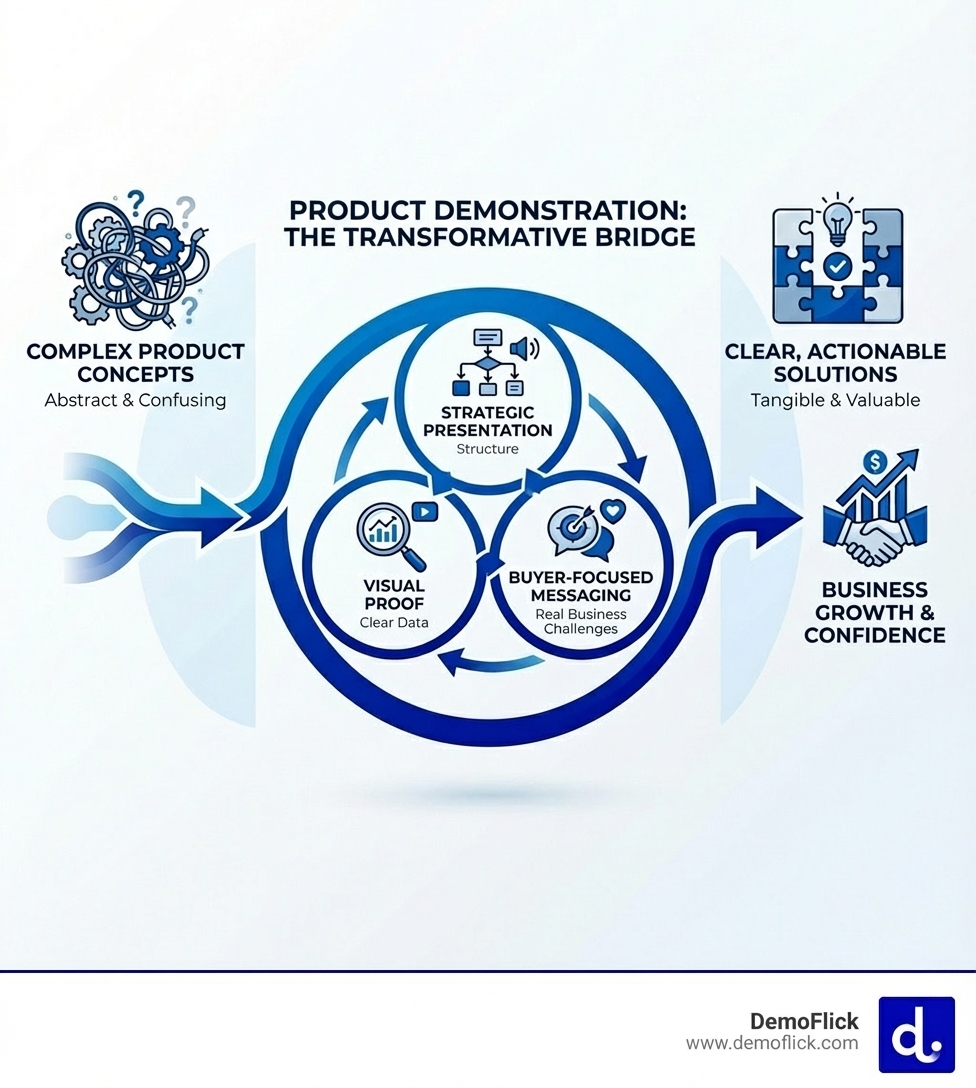
What is the True Product Demonstration Meaning in Business?
At its core, a product demonstration is a promotional and educational activity where a product is showcased to potential customers. This can involve new offerings, updated versions, or products entering a new market. The goal is to introduce customers to the product in a way that encourages a purchase and supports internal stakeholder alignment.
More than just a show and tell, it is a strategic business communication tool that provides tangible proof and helps address real business problems. When supported by professional corporate video production, a product demo becomes a repeatable asset that sales, marketing, and leadership teams can deploy across channels with consistent messaging and visuals.
It serves as a vital sales enablement and promotion strategy, allowing buyers to evaluate the product on their own terms. This visual and experiential engagement is especially important for B2B organizations that must justify investment, integration effort, and risk across multiple decision makers.
The ability for a prospect to see, feel, and interact with a product, even virtually, is generally more attractive than merely hearing a sales pitch. It allows businesses to get closer to their customers, understand their needs better, and build lasting loyalty. When captured in a clear, structured video, that experience can be delivered at scale to new regions, new segments, and partner networks.
Product demonstrations have been identified as one of the best sales tools available, making them indispensable for any business aiming for growth. They are particularly impactful when paired with a video strategy that connects your product demo with explainer videos, customer stories, and onboarding content. You can learn more about strategic use of demos in business contexts by exploring resources like The Purpose and Benefits of a Product Demonstration.
The Core Purpose: Moving Beyond Features to Solutions
The primary purpose of a product demonstration extends far beyond a simple feature list. It is about showcasing how a product solves specific customer problems, building credibility, and facilitating confident purchasing decisions among all stakeholders.
By allowing prospects to experience the product firsthand, a demo provides tangible proof of its capabilities, which is crucial for complex B2B solutions. When that demo is documented as a corporate video, it becomes a persistent resource that teams can send to new stakeholders who join the conversation later.
An effective demo focuses on demonstrating real world use cases, helping prospects envision how a solution integrates into their operations and addresses their unique challenges. This approach transforms abstract benefits into concrete solutions, making the value proposition clear and compelling.
For instance, instead of just stating that a software improves efficiency, a professionally produced demo can show a workflow where a specific pain point is eliminated, illustrate the direct impact on the business, and overlay narrative, graphics, and data to support the story.
Key Advantages Backed by Data
Product demonstrations offer a range of advantages that directly translate into business growth. One of the most significant benefits is the increase in conversion rates. Interactive SaaS product tours, for example, often show high task completion rates, which signals strong user engagement and understanding.
Businesses that incorporate interactive content like product demos often see their sales rise because they remove uncertainty and make evaluation easier. When you combine a live demo with an on demand product demo video, you give prospects a way to share the story internally without needing your sales team in every meeting.
Demos also play a critical role in shortening sales cycles by addressing concerns and building confidence early in the buyer journey. They improve lead qualification by allowing prospects to self identify their needs and assess product fit, which reduces wasted sales effort.
This also provides clear competitive differentiation. Data from a recent Wyzowl video marketing survey shows that most B2B companies now use video as part of their marketing and sales process, and many rely on product demos as a core format.
For B2B companies, the demo close rate typically falls between 20 and 50 percent. Even modest improvements in demo performance can have a significant financial impact over a year. Well prepared, customer focused demos, especially when scripted and produced by specialists, can lift close rates and reduce back and forth during the decision process.
Including customer testimonials within a demo, or pairing your demo with a short customer proof video, can also increase conversion rates by adding social proof that feels specific and credible.
Product Demo versus Sales Pitch: What Is the Difference?
While often used interchangeably, there is a distinct difference between a product demo and a sales pitch.
A sales pitch is typically a broader, conceptual presentation that focuses on the value proposition and market position of a product or service. It often involves slides and aims to persuade a prospect about the general benefits and strategic fit.
In contrast, a product demo is hands on and interactive. It moves beyond telling to showing, proving capability rather than just stating value. When turned into a high quality video, it gives prospects a clear, visual understanding of how the product behaves in real scenarios.
A demo provides a real time, often personalized, experience of the product in action. Its purpose is to address specific business needs by demonstrating actual functionality and workflows. Demos provide tangible evidence that supports sales claims, allowing prospects to evaluate solutions with clarity and confidence.
For B2B leaders, the most effective approach usually combines both. They use a strong narrative pitch to frame the problem and opportunity, then use a professionally produced demo to prove that the solution can deliver the promised outcomes at scale.
The Key Types of Product Demonstrations for B2B Growth
Understanding the various types of product demonstrations is crucial for B2B organizations, as each serves a different purpose within the sales process and buyer journey. The choice of demo format is often influenced by factors such as the B2B context, specific sales models, product complexity, and where a prospect is in their decision making process.
Formats for Every Stage of the Buyer Journey
Businesses can employ a range of product demonstration formats to engage prospects effectively at every stage of their buyer journey. Corporate video production helps turn each of these into reusable, structured assets that align sales, marketing, and leadership teams.
- Live Demonstrations: These are real time, interactive presentations, often conducted via video conference or in person. They allow for immediate questions, answers, and personalization, which is highly effective for addressing specific prospect concerns. Recording these sessions and refining them into polished demo videos can extend their value.
- Recorded Demo Videos: Pre recorded demo videos offer consistency and scalability. They are excellent for middle and bottom of funnel engagement, website content, sales follow ups, and enablement for partner channels. They can showcase core features and use cases concisely, with scripted narration and on screen graphics.
- Interactive Product Tours: These self guided experiences allow prospects to explore the product at their own pace, often with dummy data, providing a hands on feel without direct sales involvement. For SaaS companies, pairing interactive tours with a strong SaaS product demo video gives both depth and flexibility.
- Animated Demos: Using animation can simplify complex concepts, visualize abstract data flows, or show scenarios that are difficult to film. They are highly engaging and can be used to explain intricate workflows or technical concepts in a clear, memorable way, often as part of a broader explainer video strategy.
- Webinars: Group presentations that combine elements of live demos and educational content. They are effective for reaching a broader audience, demonstrating common use cases, and answering questions in a public forum. Useful segments can be edited into shorter demo clips for ongoing use.
Examples of these in a B2B context include a SaaS platform walkthrough demonstrating a specific workflow, a medical device simulation showing its operational procedure, or a financial software dashboard illustrating reporting capabilities. A Seattle based team like DemoFlick can help turn these scenarios into clear, high impact videos that support real sales conversations.
How to Choose the Right Type of Product Demonstration
Selecting the appropriate product demonstration type is a strategic decision that should align with business objectives and a prospect’s needs.
Key factors to consider include:
- Sales led versus product led growth: For sales led models, personalized live demos, often supported by tailored demo videos, are usually preferred. For product led growth, interactive product tours and self service recorded demos are crucial for user adoption and scale.
- High touch versus low touch onboarding: High touch models benefit from custom live demos and implementation content captured on video. Low touch models rely more heavily on comprehensive recorded demos, explainer videos, and interactive guides.
- Product Complexity: Simple products might thrive with short, overview videos. Complex enterprise solutions may require longer, detailed live demonstrations or a series of targeted recorded videos that speak to different departments and roles.
- Audience (Prospect versus Current Customer): Demos for prospects focus on problem solving, differentiation, and value. Demos for current customers might highlight new features, advanced use cases, integration possibilities, and training.
- Annual Contract Value (ACV): For products with lower ACV, such as less than $1,000, personalized live demos may not be cost effective, making self service or recorded demos more suitable. Higher ACV products typically warrant more involved, personalized live demonstrations and a set of supporting videos.
For a deeper look at how DemoFlick tailors SaaS demo content to business goals, you can find more information about our SaaS product demo video services.
Understanding the Product Demonstration Meaning for Sales Teams
For sales teams, the product demonstration meaning is closely tied to closing deals and accelerating the sales cycle. While some sources distinguish between a product demo for current customers and a sales demo for prospects, many B2B SaaS sales leaders use the demo to refer to the critical presentation delivered to prospective customers.
Sales demos are typically one to one, highly personalized sessions. They are carefully designed to address the unique challenges of each prospect and their specific business needs. This involves preparation, including researching the prospect’s company, industry, and stakeholders.
When sales teams pair these sessions with well produced corporate demo videos, they can control the narrative, keep messaging consistent, and give prospects a high quality asset to share internally.
During the demo, the sales team focuses on:
- One to one personalization: Tailoring the demonstration to show exactly how the solution solves the prospect’s pain points.
- Addressing stakeholder concerns: Proactively addressing potential questions or objections from various decision makers within the prospect’s organization.
- Live questions and answers: Providing immediate answers and clarification, which builds rapport and trust.
- Accelerating deals: By clearly demonstrating value and addressing concerns, demos help move prospects faster through the sales funnel.
Effective sales demos are not just feature showcases, they are strategic conversations that prove value and build confidence. To learn more about optimizing this crucial sales tool and how video supports it, refer to our guide on How to Deliver the Perfect Sales Demo.
How to Create Compelling Product Demonstration Videos
Crafting compelling product demonstration videos is an art and a science, especially in the B2B space where clarity and impact are critical. At DemoFlick in Seattle, we approach video production as a strategic exercise, ensuring every demo video effectively communicates value, supports the sales process, and drives qualified action.
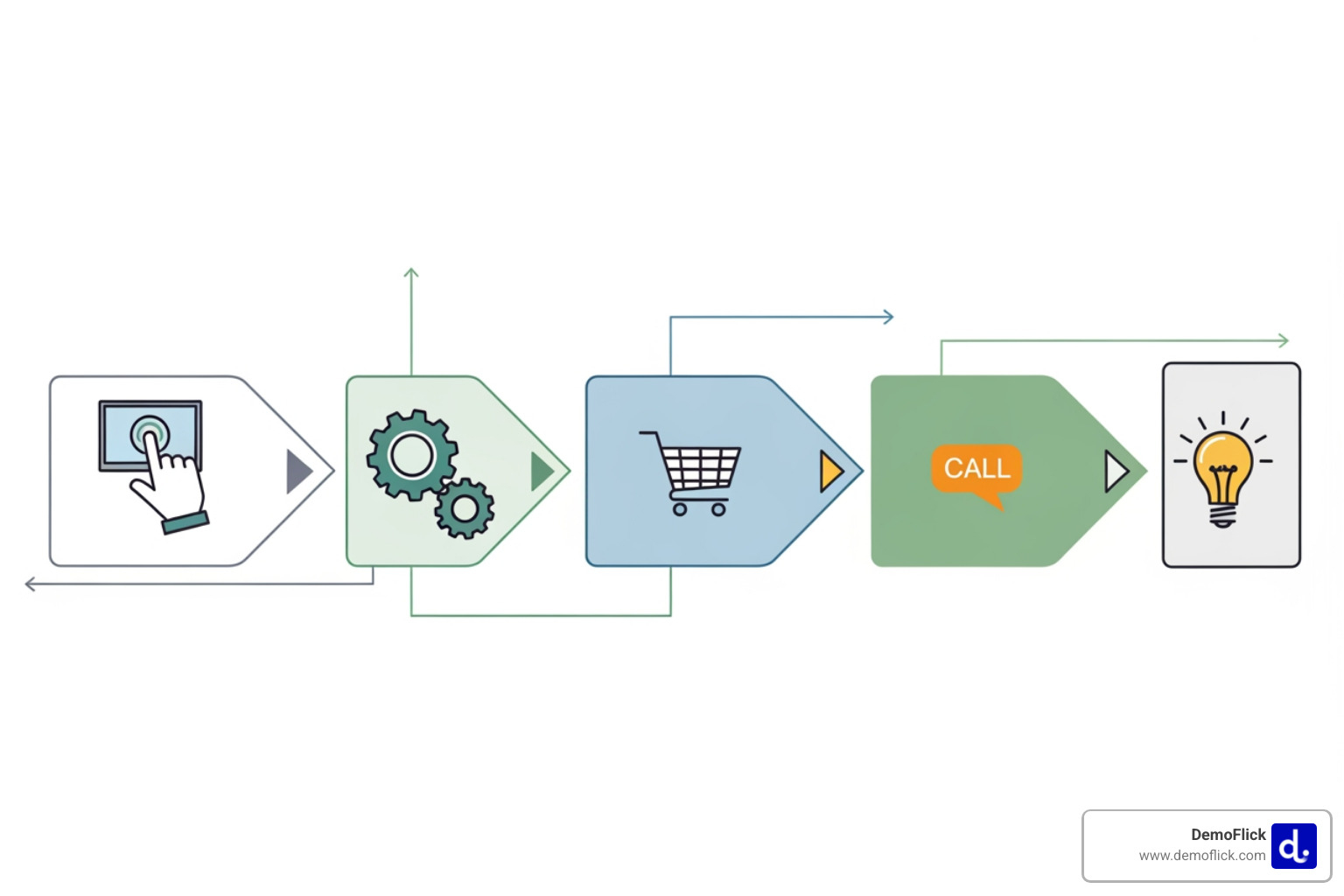
Our disciplined, comprehensive production process ensures that our clients receive high quality, narrative driven videos that truly resonate with their target audience. This is where our expertise in corporate video production services is most visible, as we help B2B organizations translate complex ideas into clear, structured video narratives.
The Strategic Blueprint for an Effective Demo Video
To create a truly effective product demo video, we follow a strategic blueprint that ensures clarity, engagement, and alignment with business goals.
- Defining audience and goals: Before we think about filming, we work with our clients to clearly identify their target audience and what specific actions they want viewers to take after watching the demo. This might include booking a live demo, involving technical stakeholders, or starting a proof of concept.
- Scripting for clarity: Our scripts are carefully crafted to focus on benefits over features. We translate technical jargon into clear, direct language, ensuring the message is understood by B2B decision makers and front line users. The script is what does most of the explanation in a demo video.
- Focusing on benefits over features: Prospects care about solutions to their problems. Our videos highlight how the product solves a problem, not just what it does. We tell a story that connects directly to their pain points, internal pressures, and business metrics.
- High quality production: Professional production values are non negotiable. This includes clear visuals, crisp audio, engaging graphics, and seamless editing. High quality production builds trust and signals legitimacy, reinforcing our client’s brand authority with every view.
- Clear call to action (CTA): Every demo video needs a clear and unambiguous call to action. Whether it is request a live demo, talk to sales, or explore a full feature tour, the CTA guides the viewer to the next logical step in their buying process.
Effective demo videos are short and to the point, typically 1 to 3 minutes for general awareness and sales enablement, ensuring the viewer remains interested until the end. For more complex buying processes, we often design a sequence of demo and explainer videos, each focused on a specific audience or stage.
We focus on showing, not just telling, using visuals to make the product’s value immediately apparent. That is the core of product demonstration meaning when it is translated into video.
The Product Demonstration Meaning in the SaaS Industry
The product demonstration meaning has particular significance in the SaaS industry, where intangible software products require clear visualization of their value.
Demos are crucial for product led growth strategies, user onboarding, and driving feature adoption. They are also instrumental in reducing churn by ensuring users understand and effectively use the software from the first week.
Different SaaS business models call for distinct demo strategies:
| SaaS Business Model | Annual Contract Value (ACV) | Demo Strategy |
|---|---|---|
| Self Service | < $1,000 | Primarily uses automated, self service demos like interactive product tours and on demand videos. The goal is to enable users to find value independently with minimal sales interaction, supported by concise explainer videos. |
| Transactional | < $5,000 | A hybrid approach combining self service resources with sales led demos for qualified leads. Sales teams often handle several demos per week in this model, focusing on prospects who need extra guidance. Well structured demo videos help standardize the story. |
| Enterprise | > $100,000 | Relies on high touch, deeply personalized live demonstrations delivered by sales engineers or senior account executives. These demos are custom to complex business requirements and involve multiple stakeholders. Supporting demo videos help with alignment between technical, financial, and executive teams. |
The average SaaS company performs multiple demos each week, which highlights the constant need to effectively communicate product value. For SaaS companies, explainer videos are often used alongside demos to simplify complex concepts and introduce new features.
You can find more information about our explainer video production services that help break down intricate offerings into clear, memorable explanations. This ensures that prospects and current customers alike can quickly grasp the value of a company’s solutions.
Potential Drawbacks and How to Avoid Them
While product demonstrations are powerful, they are not without challenges. Businesses must be mindful of potential drawbacks to ensure their investment yields the best possible returns.
- Cost of production: High quality product demos, especially video productions, require a real investment in resources, time, and expertise. This can be mitigated by focusing on strategic content that delivers clear impact and can be repurposed across multiple channels, regions, and teams.
- Time investment: Demos require a time investment for both creation and delivery, especially for live, personalized sessions. For sales teams, investing time in the wrong prospects can be costly. A rigorous qualification process and smart use of on demand demo videos ensures that live demo time is reserved for well suited prospects.
- Risk of technical issues: Live demos are susceptible to technical glitches, internet connectivity problems, or software malfunctions. It is important to prepare carefully, test equipment, have backup plans, and maintain realistic demo environments to minimize these risks.
- Keeping content current: Products evolve rapidly, particularly in SaaS. Demos can quickly become outdated. We recommend regular updates after major releases and quarterly reviews to refine flow, messaging, and customer examples, ensuring your demos always reflect the latest capabilities.
- Maintaining a realistic demo environment: Using outdated or unrealistic data in a demo can undermine credibility. Ensure demo environments are refreshed with relevant, industry specific data and scenarios that resonate with prospects. For video, that means updating screen captures, overlays, and examples.
By proactively addressing these potential pitfalls, businesses can ensure that their product demonstrations remain powerful, effective tools that support revenue, customer success, and internal alignment.
Frequently Asked Questions about Product Demonstrations
How does a professionally produced product demo impact B2B conversion rates?
A well produced product demo clarifies value, reduces perceived risk, and creates a consistent story that sales, marketing, and leadership can all share. B2B teams often see higher close rates and shorter sales cycles because stakeholders can align more quickly around a clear, visual proof of how the solution works.
When should we invest in a dedicated product demonstration video instead of relying on live demos?
You should invest in a dedicated demo video when your sales team repeats the same core narrative, when multiple stakeholders join late in the process, or when you sell into new regions or channels. A polished video scales your best demo, supports partners, and frees sales to focus on higher value conversations.
How does corporate video production improve the effectiveness of our product demonstrations?
Corporate video production adds structure, clarity, and polish to your demos. It turns an ad hoc walkthrough into a scripted, visual narrative that highlights business outcomes, aligns with your brand, and removes distractions. This makes it easier for executives and non technical stakeholders to understand and champion your solution.
What should B2B decision makers look for in a video partner for product demos?
Look for a partner that understands B2B buying, not just video craft. They should ask about your sales process, buyer roles, and key objections. Strong partners offer strategy, scripting, and structure in addition to production, and can show examples of corporate, explainer, and SaaS demo work that drove real business results.
How can we measure the ROI of product demonstration videos?
Measure ROI by tracking how demo videos influence pipeline and deal quality. Common indicators include increased demo requests, higher conversion from opportunity to close, shorter decision timelines, improved stakeholder engagement, and better onboarding outcomes. Combining view analytics with sales feedback gives a clear picture of impact.
Conclusion
Understanding the product demonstration meaning reveals that it is far more than a simple showcase. It is a strategic asset for B2B organizations that need to communicate complex value clearly to multiple stakeholders.
Effective product demonstrations, especially when captured through professional corporate video production, provide business clarity, drive action, and build confidence among prospects and customers. By moving beyond features to focus on real world solutions, businesses empower buyers to make informed decisions, which leads to higher conversion rates and stronger growth.
At DemoFlick in Seattle, we specialize in turning complex ideas into clear, structured video narratives that reduce friction in the buyer journey and accelerate understanding. Our expertise in corporate video production, explainer videos, and SaaS product demo videos ensures that your message is not just heard, but understood and shared accurately inside your prospect’s organization.
We believe that clarity is a business advantage. Our process driven approach is designed to deliver precisely that, whether you are equipping your sales team with better tools, aligning internal stakeholders, or supporting partner and channel programs.
To see how our strategic video production can support your B2B organization, we invite you to explore our video production process and learn how we help clients communicate with confidence and purpose at every stage of the buying journey.

DemoFlick
https://www.demoflick.comDemoFlick is a corporate video production agency creating explainer videos, product demos, and brand videos that turn complex ideas into clear, effective stories that drive real business results.