Unlock Your Business Potential: Crafting a Winning B2B Video Marketing Plan

Why B2B Video Marketing Strategy Matters More Than Ever
A B2B video marketing strategy is a structured approach to creating, distributing, and measuring video content that educates buyers, simplifies complex solutions, and supports business growth across the sales cycle. It aligns video production with business objectives like lead generation, sales enablement, and buyer education rather than treating video as isolated creative projects.
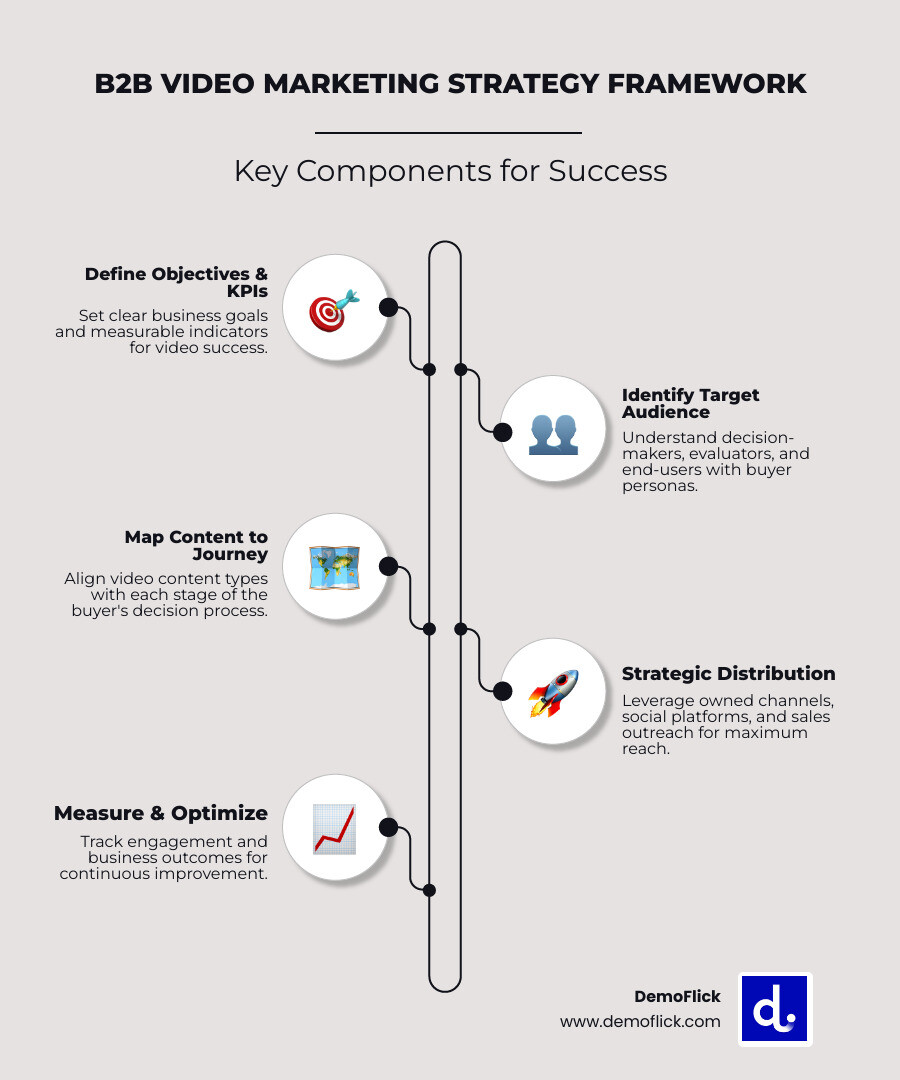
Key components of an effective B2B video marketing strategy:
- Clear business objectives tied to measurable KPIs like conversion rates and pipeline velocity
- Audience segmentation addressing decision makers, technical evaluators, and end users
- Content mapped to the buyer journey from awareness through decision
- Strategic distribution across owned channels, social platforms, and sales outreach
- Measurement and optimization using engagement data and business outcomes
Video is no longer optional for B2B organizations competing in complex markets. According to Wyzowl, 91% of businesses used video as a marketing tool in 2023, and 88% of marketers report a positive ROI from video content. When buyers research solutions, they expect video. When sales teams reach out, video clarifies value faster than text. When products require explanation, video reduces friction.
The shift is driven by how buyers make decisions. B2B purchase processes now involve multiple stakeholders, longer research cycles, and higher expectations for clarity before engaging with sales. Video addresses these challenges directly. It builds trust through visual proof, simplifies technical concepts through demonstration, and scales communication across teams and geographies.
The challenge is not whether to use video, but how to use it strategically. Many B2B organizations produce videos inconsistently, without clear goals or distribution plans. Others invest in high production content that never reaches the right audience. A strategic approach ensures every video serves a business purpose, supports a stage of the buyer journey, and contributes to measurable outcomes like qualified leads or shorter sales cycles.
This guide walks through the six essential steps to building a B2B video marketing strategy that drives results: defining objectives, understanding your audience, planning content for the buyer journey, choosing the right production approach, selecting distribution channels, and establishing measurement systems. You will also see which video formats deliver the highest ROI at each stage of the funnel and how to justify video investment to leadership.
Why Video is a Strategic Imperative for B2B Growth
Video has rapidly evolved from a “nice to have” to a strategic imperative for B2B organizations. Its ability to capture attention and convey complex information efficiently makes it an best tool for building trust, generating leads, and enabling sales. In fact, 88% of marketers report a positive ROI from video, a significant jump from just 33% in 2015.
The sheer volume of online video consumption underscores its importance: 82% of all internet traffic consisted of online video in 2022. This trend shows no sign of slowing, with total watch time for business content increasing by 44% compared to 2022. Video content drives 1,200% more engagement than text and static images combined, ensuring our messages cut through the digital noise. What is more, 95% of a video’s message is retained by viewers, compared to only 10% with text, making it incredibly effective for educating buyers and fostering long term customer retention.

This effectiveness is rooted in human psychology. Our brains are hardwired to connect with human faces, creating an immediate emotional connection that text alone cannot match. Video leverages this, allowing B2B brands to humanize their solutions and build genuine relationships. For businesses, this translates into tangible benefits: 49% faster revenue growth for those using video, and a significant boost in lead generation and sales enablement.
Clarifying Complexity and Building Buyer Confidence
B2B products and services are often inherently complex, involving technical specifications, intricate workflows, and significant investment decisions. Explaining these effectively through text alone can be challenging, leading to buyer confusion and friction in the sales process. This is where video shines. A TechSmith survey shows 83% of people prefer video for instructional or informational content rather than written documentation.
Video provides clarity by demonstrating solutions visually, making abstract concepts tangible, and illustrating value propositions in action. We use video to simplify complex products, services, and workflows into clear, structured narratives that support decision making. This approach aligns with buyer preferences: 96% of people have watched an explainer video to learn more about a product or service.
Moreover, buyers often need to get buy in from multiple team members, sometimes seven to eight other individuals, making a clear, concise, and shareable explanation invaluable. Personalized demos, delivered via video, are also highly preferred, with 94% of buyers wanting custom experiences. B2B audiences are often willing to invest time in longer videos because the content is focused on delivering depth and insight that aligns with their needs. Video, therefore, not only clarifies but also builds confidence, reducing friction and accelerating the buyer journey.
The Key Differences Between B2B and B2C Video
While both B2B and B2C marketing use video, their strategic approaches, audience focus, and content styles differ significantly. Understanding these distinctions is crucial for crafting an effective B2B video marketing strategy.
| Attribute | B2B Video Marketing | B2C Video Marketing |
|---|---|---|
| Goal | Logic, Education, ROI, Problem Solving | Emotion, Entertainment, Lifestyle, Instant Gratification |
| Audience | Decision makers, Buying Committees, Professionals | Individual Consumers, General Public |
| Sales Cycle | Long, Multiple stakeholders, Complex | Short, Individual, Impulse Driven |
| Content Focus | Explanations, Demos, Case Studies, Thought Leadership | Product Showcases, Trends, User Generated Content, Humor |
B2B video marketing takes a strategic, targeted approach aimed at business decision makers. Our content focuses on providing in depth information, demonstrating clear return on investment, and showcasing how our solutions address specific business challenges. The goal is to build long term relationships and facilitate rational, well informed purchasing decisions.
In contrast, B2C video marketing is often fast paced and emotion driven, relying on quick engagement and lifestyle aspirations. These videos typically feature short form content prioritizing entertainment and immediate emotional connection. While B2B is increasingly adopting engaging storytelling techniques, the core purpose remains rooted in professional value and strategic solutions.
The 6 Essential Steps to Building Your B2B Video Marketing Strategy
Building a successful B2B video marketing strategy requires more than just creating great videos; it demands a systematic approach that aligns video content with overarching business goals. Here are the six essential steps we follow to help our clients develop a robust and effective strategy.

1. Define Clear Business Objectives and KPIs
Every successful video marketing effort begins with clearly defined business objectives. We need to know what we aim to achieve. Are we focused on generating more qualified leads, enhancing brand authority, accelerating sales conversions, improving customer onboarding, or establishing thought leadership?
Once objectives are set, we identify the key performance indicators (KPIs) that will measure our success. These go beyond vanity metrics like view count. We track metrics such as lead conversion rates from video landing pages, the impact on sales cycle length for prospects who engaged with video, customer retention rates influenced by onboarding videos, and customer acquisition cost. For instance, one B2B video marketing team increased qualified leads by 30% and reduced the sales cycle by nearly three weeks using detailed product demonstration videos with clear ROI calculations. As Vahbiz Cooper, a digital marketer for Demandbase, advises, “If you’re just starting out, don’t stress about making it perfect. Start small. Pick one goal — like building awareness or generating leads — and one format, maybe a customer testimonial or a how to video.”
2. Identify and Understand Your Target Audience
Understanding your target audience is paramount in B2B marketing. Unlike B2C, where emotional appeal often drives purchases, B2B decisions involve multiple stakeholders, each with distinct needs and concerns. We need to define our buyer personas, considering their industry, job roles (C suite, technical evaluators, end users), pain points, and specific challenges.
B2B customers tend to do more research and need to gain buy in from several team members, making it crucial to tailor our messaging to each segment. For example, a C level executive might prioritize ROI and strategic impact, while a technical evaluator will focus on features and integration capabilities. Research shows that 94% of buyers prefer demos custom to their specific use case, highlighting the importance of personalized, audience centric content. By understanding who is watching and what they care about, we can craft videos that resonate deeply and effectively guide them through their decision making process.
3. Develop a Content Plan for the Entire Buyer Journey
A comprehensive B2B video marketing strategy maps video content to each stage of the buyer journey: Awareness, Consideration, and Decision. This ensures we provide relevant information at every touchpoint, nurturing prospects effectively.
- Awareness Stage: At the top of the funnel, our videos introduce problems our audience faces and position us as a knowledgeable resource. This includes brand videos, thought leadership interviews, and animated explainer videos that highlight industry trends or common pain points. Our Explainer Video Production service excels here, simplifying complex concepts to generate initial interest.
- Consideration Stage: As prospects research solutions, our videos educate them on how our offerings specifically address their challenges. Product demo videos, case studies, customer testimonials, and webinar recordings are ideal. These showcase our expertise and differentiate us from competitors.
- Decision Stage: At the bottom of the funnel, videos provide the final validation needed for purchase. This can involve personalized sales videos, detailed implementation guides, or “About Us” and team culture videos that build confidence in our partnership. Our Corporate Video Production helps establish credibility and trust during this critical phase.
This structured approach ensures that every video serves a purpose, guiding prospects seamlessly towards conversion.
4. Choose the Right Production Approach and Budget
Deciding on the right production approach involves balancing quality, authenticity, and budget. While 46% of first time video marketers started using video in 2019, many quickly realize the complexities involved. We guide our clients in determining whether an in house production or an agency partnership is best for their specific needs.
For high stakes, strategic assets like brand films, comprehensive product demos, or corporate messaging, partnering with a professional video production company like DemoFlick can avoid the investment in specialized equipment, videographers, and scriptwriters. This ensures a polished, professional output that reflects our brand’s credibility. Our Video Production Process is designed to provide a disciplined, complete solution for B2B teams.
However, authenticity is also highly valued by B2B audiences. As Deni Ivanov, digital marketing manager at Royal Clean, puts it, “What doesn’t work for us is highly polished, overly produced videos. Our audience values authenticity, so we’ve pivoted to low budget but relatable content filmed with smartphones or basic equipment.” We believe the best approach often involves a hybrid model: professional production for core, high impact videos, and empowering internal teams for more agile, authentic content like personalized sales outreach or quick social media updates. The key is to balance quality with the right level of polish for each video’s purpose and audience.
5. Select Strategic Distribution Channels
Creating compelling video content is only half the battle; ensuring it reaches the right audience is equally critical. Our B2B video marketing strategy emphasizes strategic distribution across channels where our target decision makers are most active.
LinkedIn stands out as a powerful platform for B2B video. Video content is shared 20x more on LinkedIn than any other content type, and 87% of LinkedIn video marketers describe it as an effective channel. LinkedIn’s 2024 B2B Marketing Benchmark report found that video is both the top content type currently used by B2B organizations and the leader in planned usage going forward.
Our company website is another cornerstone for video distribution. Adding video to our homepage, landing pages, or product pages increases the average time visitors spend on a page, and landing pages featuring video see increases of over 80% in conversions. Embedding videos on sales pages or within our SaaS Product Demo Video content can significantly reduce friction in the buyer journey.
Email marketing, often overlooked for video, offers substantial impact. When companies embed email sign up forms within videos, 23% of viewers take action, a conversion rate that outshines traditional calls to action, which average around 13%. This tactic is gaining traction, with video in email marketing increasing from 36% in 2016 to 55% in 2018. YouTube also remains a vital platform, seeing 6 billion searches a day and serving as the world’s second largest search engine for educational content.
6. Establish a Process for Measurement and Optimization
A truly effective B2B video marketing strategy is iterative, constantly refined through rigorous measurement and optimization. We establish clear processes to track our video performance, providing invaluable insights into what resonates with our audience and what needs adjustment.
Key metrics we monitor include:
- View Count: The total number of times a video has been watched.
- Watch Time/Average View Duration: The total or average amount of time viewers spend watching our videos.
- Engagement Rate: Measures likes, comments, shares, and other interactions.
- Click Through Rate (CTR): The percentage of viewers who click on a call to action within or after the video.
- Conversion Rate: The percentage of viewers who complete a desired action, such as downloading a whitepaper or requesting a demo.
- Audience Retention: Identifies specific moments where viewers drop off, indicating areas for content improvement.
Video analytics offer deeper insights into buyer preferences than traditional metrics, revealing engagement patterns, drop off points, and rewatch habits. We integrate these insights with lead tracking and marketing automation systems to understand the direct impact of video on our sales pipeline. Regular A/B testing of video elements, from thumbnails to calls to action, allows us to continuously optimize performance. As Elise Montanari, head of organic growth at Wrike, advises, “You won’t always know what will perform well until you see the performance metrics, so don’t be afraid to get your hands dirty and dig into as many different opportunities as possible.” This systematic approach ensures our video efforts are always improving and delivering maximum business impact.
High ROI Video Formats for Every Stage of the B2B Buyer Journey
Mapping video content to the buyer journey is fundamental to a high ROI B2B video marketing strategy. Different video formats excel at different stages, addressing specific buyer needs and moving them closer to a decision.
Top of Funnel: Building Awareness and Trust
At the awareness stage, our goal is to introduce a problem, capture attention, and establish our brand as a credible resource.
- Brand Videos: These tell our company’s story, highlight our mission, and convey our values, helping prospects connect with our brand on a deeper level.
- Thought Leadership Interviews: Featuring industry experts or our own leadership, these videos share insights, discuss trends, and position us as authoritative voices in our field.
- Animated Explainer Videos: Perfect for simplifying complex concepts or introducing a new solution, these videos engage viewers with clear, concise visuals and narratives. Our Explainer Video Production focuses on making intricate ideas digestible and memorable for initial engagement.
- Industry Trends Videos: Highlighting key shifts or challenges in the market, these videos demonstrate our understanding of our audience’s world and spark initial interest.
Middle of Funnel: Educating and Differentiating Your Solution
Once prospects are aware of a problem and researching solutions, our videos educate them on our specific offerings and how we differentiate ourselves.
- Product Demo Videos: These are crucial for B2B. They showcase our product’s features, demonstrate its functionality, and illustrate how it solves specific pain points. Research shows 94% of buyers prefer demos custom to their specific use case. Our SaaS Product Demo Video service provides guided walkthroughs that highlight real workflows and use cases.
- Case Studies: These videos present real world examples of how our solutions have helped other businesses achieve success, providing tangible proof of value.
- Customer Testimonials: Featuring satisfied clients sharing their positive experiences, these videos build social proof and trust. An impressive 95% of medium sized businesses report at least a 10% boost in conversion rates when using video testimonials.
- Webinar Recordings: Offering in depth discussions on specific topics, these videos position us as experts and provide valuable educational content that prospects can consume at their own pace.
Bottom of Funnel: Driving Decisions and Closing Deals
At this critical stage, our videos provide the final reassurance and detailed information needed for a prospect to make a purchase decision.
- Personalized Sales Videos: Custom videos sent directly to prospects can address specific questions, recap discussions, or provide custom demonstrations, adding a highly personal touch to the sales process. Sales teams using video often see significant growth in performance.
- Implementation Guides: For complex software or services, videos that walk through the setup or initial use of a product can alleviate concerns about adoption and ease of use.
- Detailed ROI Calculators (Visualized): Presenting the potential return on investment in a clear, visual video format can be a powerful tool for final justification.
- “About Us” and Team Culture Videos: These videos humanize our brand, showcasing our team, values, and commitment to client success. They help prospects feel confident about partnering with us. Our About Us content often leverages video to foster this connection.
These targeted video formats ensure that our content supports buyers at every step, reducing uncertainty and building confidence towards a positive decision.
Frequently Asked Questions about B2B Video Marketing Strategy
How do I justify the ROI of a B2B video marketing strategy to leadership?
To justify ROI, focus on business outcomes, not just views. Track metrics like lead conversion rates from video landing pages, sales cycle length for prospects who engaged with video, and customer retention from onboarding videos. Present video as a tool that directly supports sales enablement, clarifies complex products, and builds measurable trust with buyers.
What is more important for B2B video: high production quality or authenticity?
For B2B audiences, clarity and credibility are most important. While high production quality builds trust and reflects brand professionalism, authenticity ensures the message resonates. The best strategy is a balance: use a professional production partner for key assets like brand films or product demos, and empower your team to create authentic, lower production videos for sales outreach.
How long should a B2B marketing video be?
Video length should match its purpose and platform. For social media awareness, aim for under 60 seconds. Explainer videos and product overviews work well between 90 seconds and 3 minutes. In depth product demos, webinars, or case studies can be longer, as decision makers will invest time to understand a solution that solves a significant problem.
Conclusion: Turn Your Strategy into a Competitive Advantage
In today’s competitive landscape, a well crafted B2B video marketing strategy is not merely a marketing tactic; it is a fundamental strategic asset. It empowers us to communicate complex ideas with unparalleled clarity, build unwavering credibility, and foster stronger relationships with our target audience. By strategically integrating video across the buyer journey, we reduce friction, accelerate understanding, and drive measurable business outcomes.
From Seattle, we specialize in helping B2B organizations like yours transform how you engage buyers, clarify your value, and accelerate growth. By implementing a structured B2B video marketing strategy, you can transform how you engage buyers, clarify your value, and accelerate growth. Ready to open up your business potential? Get a Quote from us today and let us help you craft a winning video strategy that delivers tangible results.

DemoFlick
https://www.demoflick.comDemoFlick is a corporate video production agency creating explainer videos, product demos, and brand videos that turn complex ideas into clear, effective stories that drive real business results.