Unlocking Sales Superpowers: A Definitive Guide to Enablement

What Sales Enablement Is and Why Every B2B Team Needs It
What is sales enablement? It is the strategic, organization wide process of equipping sales and customer facing teams with the content, training, tools, and insights they need to engage buyers with clarity and relevance. For B2B companies, especially those with complex products or services, sales enablement turns every interaction into a structured, high value conversation that supports revenue targets.
In practical terms, sales enablement is a strategic function that provides sales teams with resources to improve performance and protect pipeline quality. It spans content like case studies and product videos, training for onboarding and skill development, and tools such as CRM and analytics platforms. The primary goal is to increase win rates, shorten sales cycles, and drive profitable revenue growth. Organizations with sales enablement achieve a 49% win rate on forecasted deals, compared to 42.5% for those without.
Sales enablement is not a one time training session. It is an ongoing, cross functional effort that bridges the gap between marketing, sales, product, and buyer expectations. Modern B2B buyers expect personalized, value driven experiences, with 64% of B2B decision makers stating they will not engage a salesperson if the communication is not personalized.
For teams selling complex solutions, the ability to explain and visualize that value clearly is critical. This is where strategic video content, such as Corporate Video Production, Explainer Video Production, and SaaS Product Demo Video, becomes a core sales enablement asset.
Enablement ensures sellers have the right information and story at the right time, turning sales into a repeatable growth engine. Companies with formal programs see higher win rates, faster ramp times, and increased deal sizes. They build a scalable sales process that does not rely only on top performers and that is supported by consistent, on brand communication.
This guide explains what sales enablement is, why it matters, and how to build and measure a successful strategy. It is written for B2B leaders who want to use structured communication and strategic video to remove friction from the buyer journey and support marketing, sales, product, and leadership teams.
What is Sales Enablement and Why Is It a Business Imperative?
In today’s B2B landscape, a great product is not enough. Complex solutions need clear stories, and sales teams need every advantage to connect with discerning buyers. This is where what is sales enablement becomes the strategic backbone that supports every sales effort and every message your organization puts in front of the market.
At its core, sales enablement equips customer facing teams with the content, training, tools, and insights needed to succeed across the full buyer journey. It is a continuous process that ensures every seller delivers value in each interaction and can explain your solution with confidence and consistency. This is critical, as 64% of B2B decision makers say they will not engage a salesperson if the communication is not personalized.
Sales enablement is a competitive differentiator because it helps meet high buyer expectations while protecting brand credibility. By standardizing sales processes and providing superior resources, organizations can increase sales productivity, achieve higher win rates, and shorten sales cycles. For example, organizations with sales enablement achieve a 49% win rate on forecasted deals, compared to 42.5% for those without. This represents a substantial and measurable impact on revenue.
For companies that sell complex products or operate in regulated or technical markets, enablement increasingly centers on high quality video assets that make the story easy to understand. Strategic Corporate Video Production and Explainer Video Production turn dense messaging into clear, repeatable narratives that every rep can use.
Investing in enablement strategically improves the entire go to market function. It aligns marketing, sales, product, and leadership around the same story, and it provides a clear path to competitive advantage as selling becomes more complex.
The Key Benefits of a Formal Enablement Program
A structured sales enablement program yields many benefits that contribute directly to business success and pipeline health:
- Increased Deal Size: Reps equipped to articulate value, cross sell, and upsell achieve an average 14% increase in deal size.
- Higher Quota Attainment: With consistent support, sales teams are more likely to meet their targets, leading to an 84% achievement rate for sales quotas.
- Improved Customer Retention: Knowledgeable reps build stronger relationships, resulting in a 60% higher customer retention rate.
- Scalable Success: Enablement provides every rep with proven tools and strategies, including reusable video assets, making the sales process repeatable and scalable.
- Better Company Reputation: Informed and personalized sales interactions build a reputation for expertise, reliability, and clear communication.
- Data Driven Decision Making: Enablement technology helps collect and activate data on buyer preferences, allowing for smarter content investments and strategic decisions.
How Sales Enablement Drives Revenue Growth
Sales enablement is a powerful engine for revenue growth. It aligns sales with business goals by tailoring initiatives to impact key objectives like market share, deal size, or product adoption.
It improves seller effectiveness by providing the knowledge and skills to steer complex sales cycles and explain intricate solutions in simple terms. This reduces time spent on non selling activities, as enablement centralizes information that reps previously spent hours researching.
Enablement also creates consistent customer experiences through standardized messaging, modular content, and reusable assets such as SaaS Product Demo Video. This consistency builds trust and reinforces the value proposition. Finally, it reduces ramp time for new hires with structured onboarding programs and on demand video training, making them productive sooner and positively impacting revenue.
The Core Components of a Winning Sales Enablement Strategy
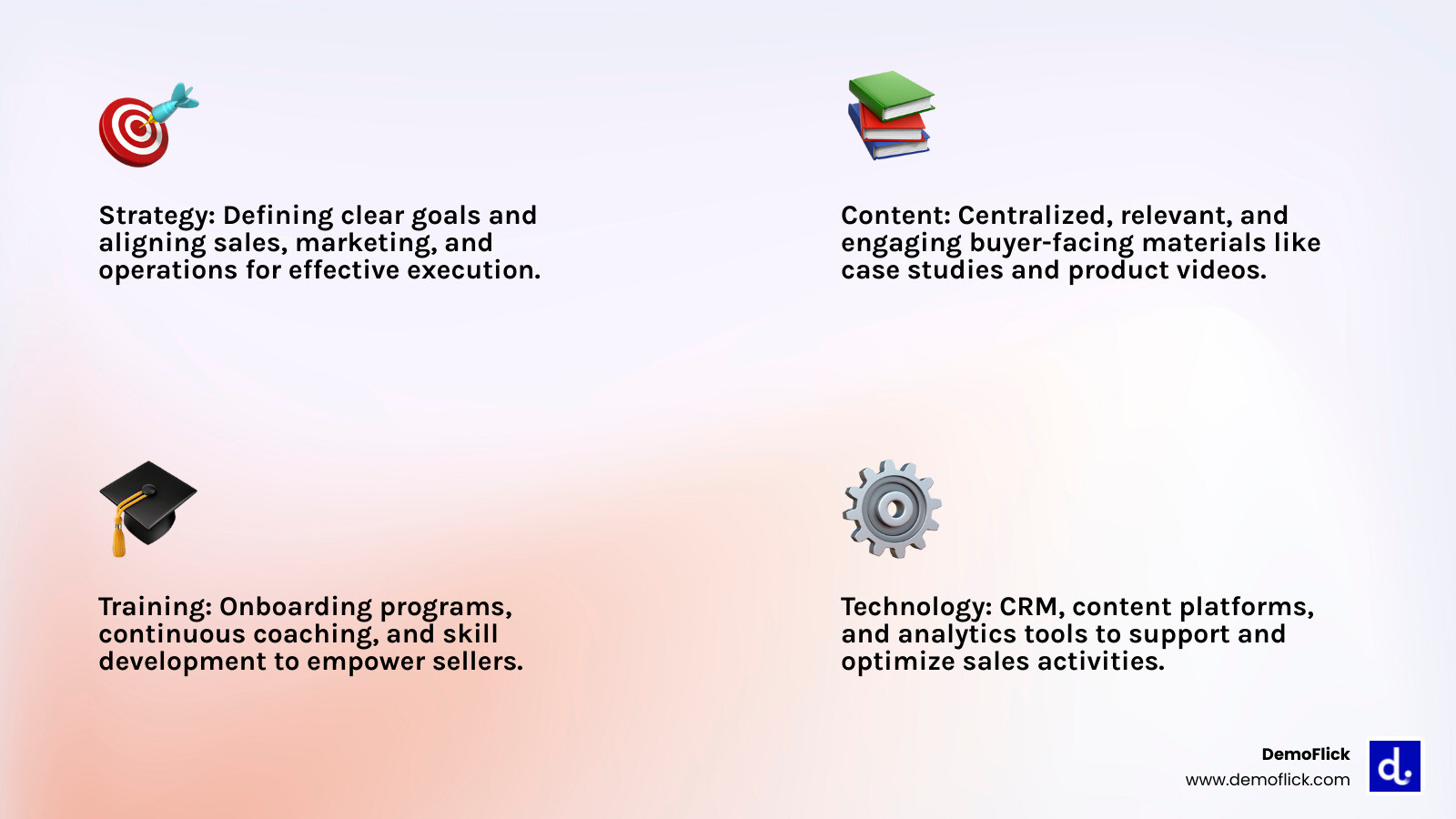
A robust sales enablement strategy integrates several key components to ensure sales teams are prepared, knowledgeable, and supported. Experts identify these elements as strategy, customer focus, content, training, technology, and metrics. For organizations with complex solutions, high quality video content sits within each of these pillars as a primary communication tool.
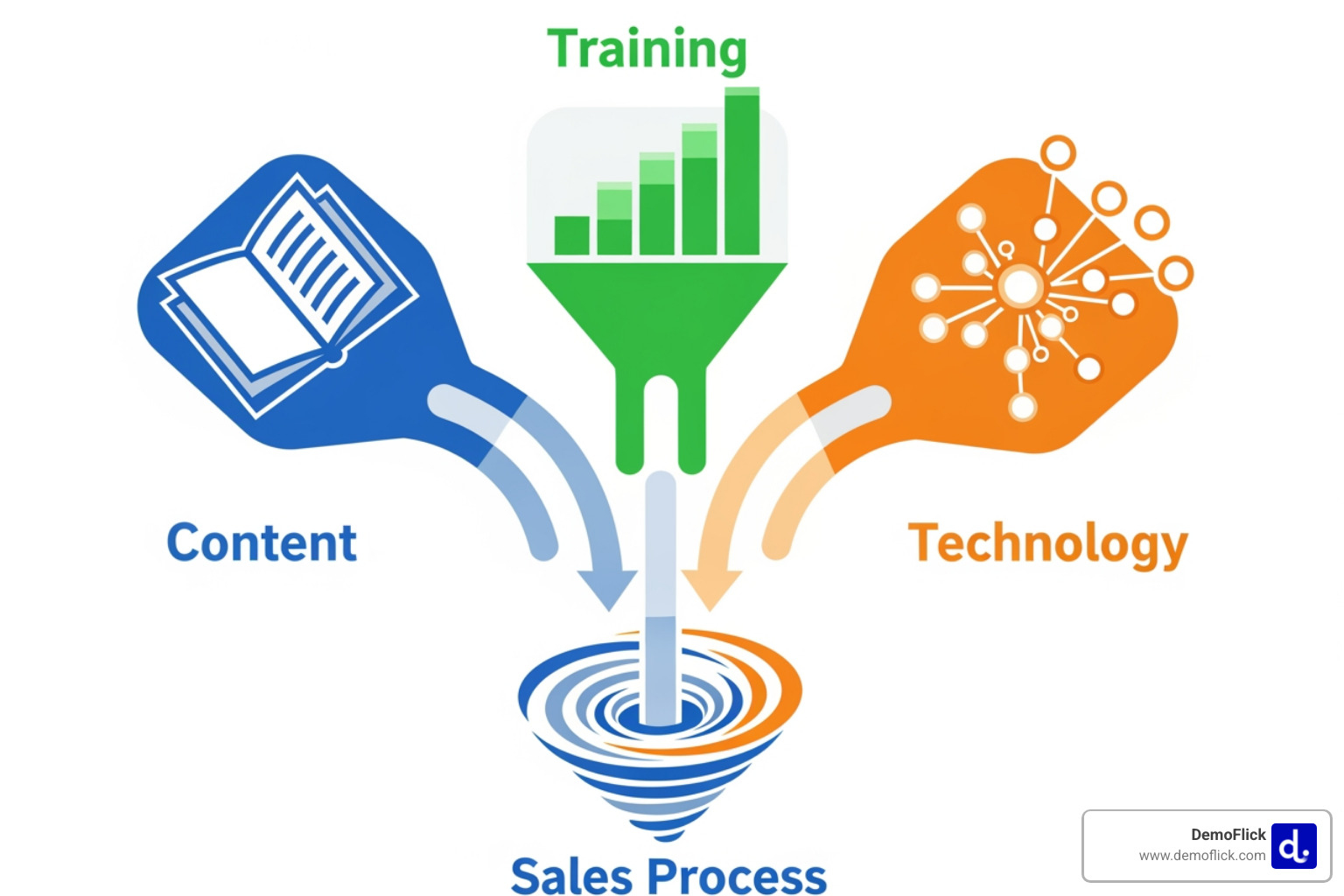
At the heart of enablement is strategic alignment. This involves mapping the business strategy to sales execution and ensuring enablement efforts sync with organizational goals, target segments, and revenue priorities. The process is iterative, requiring continuous adaptation based on performance data and feedback from the field.
What is sales enablement content?
Sales enablement content fuels the sales engine, providing professionals and prospects with information to understand and value your products. This content must be strategic, relevant, channel appropriate, and easy for sellers to access in the tools they already use. In fact, over 75% of enablement teams are involved in creating sales content.
Key types of sales enablement content include:
- Centralized Content Library: A single, searchable repository for all sales collateral. This internal library must be regularly audited and organized to maintain relevance.
- Case Studies: Customer success stories are critical for building trust and demonstrating tangible results. Video testimonials are particularly powerful for providing social proof across sales, marketing, and leadership presentations.
- Battle Cards: Concise documents that equip reps with key facts about competitors, common objections, and unique selling propositions.
- Pricing Guides: Clear pricing information is a top priority for B2B buyers. Transparent guides can build trust early in the sales process.
Visual communication is a powerful tool in sales enablement, as many buyers prefer video over written content. Strategic video content can transform complex features into clear narratives, accelerating buyer understanding and shortening the time to value. For example, a well crafted SaaS Product Demo Video or Explainer Video Production can make intricate offerings memorable and ensure your value proposition is explained the same way by every rep.
Training and Coaching That Builds Confidence
Content is vital, but effective training and coaching are required for reps to use it optimally. Sales enablement training builds confidence and ensures the team can speak authoritatively and consistently about your products.
Key aspects include:
- Onboarding Programs: Structured onboarding helps new hires reach full productivity quickly by introducing them to the sales process, tools, and culture.
- Continuous Learning: Ongoing training keeps the team updated on product changes, market trends, and best practices.
- Skill Development: This focuses on refining core selling skills like active listening, negotiation, and presentation.
- Product Knowledge Training: Reps must be experts on what they sell, understanding every feature, benefit, and use case.
- Value Selling: Training teams to sell on the value a solution provides, rather than on price, helps articulate the return on investment for clients.
- Objection Handling: Equipping reps with strategies to address common objections helps them steer challenging conversations confidently.
Engaging, multimedia training solutions can significantly improve knowledge retention and ensure the same message is delivered across regions and teams. The average viewer retains 95 percent of content watched, compared to only 10 percent of content read. This makes video an unparalleled tool for delivering impactful sales training, and services like Corporate Video Production can help create compelling internal training and sales enablement videos that drive consistent execution.
Technology and Tools to Boost Your Team
Technology is an indispensable partner in sales enablement, reinforcing plans and automating repeatable tasks. Essential technologies include:
- CRM Systems: The central hub for all customer data, providing visibility into the customer journey and content touchpoints.
- Content Management Platforms (CMS): These platforms organize and distribute sales content, ensuring reps can easily find and share materials.
- Learning Management Systems (LMS): An LMS delivers and tracks training programs, making continuous learning accessible and measurable.
- Conversation Intelligence: Tools powered by AI analyze sales calls, providing actionable insights for coaching and strategy refinement.
Other tools include sales acceleration and intelligence software, automation platforms, and predictive analytics. These advanced tools can offer prescriptive recommendations on the next best actions and highlight where strategic assets like product demo videos close knowledge gaps. By thoughtfully integrating these technologies, we empower sales teams to work smarter, communicate more clearly, and be more effective.
Building and Executing Your Strategy: Best Practices and Team Structure
An effective sales enablement strategy requires thoughtful execution, collaboration, and continuous improvement. It is about building a system that fosters synergy across the organization and that uses standardized content, including video, to keep messages aligned from marketing through post sale.
A cornerstone of successful enablement is cross functional collaboration, especially strong alignment between sales and marketing teams. As one expert noted, this alignment has many branching benefits of its own. This includes shared goals, consistent messaging, and a unified market approach.
Your strategy must be focused on the buyer journey. This means understanding prospect needs and decision processes at every stage to provide the right content at the right time, in the right format. Often this involves a mix of written assets and modular videos that reps can plug into emails, presentations, and follow ups.
Finally, sales enablement is an iterative process. It requires constant adaptation based on performance data and feedback, which demands strong stakeholder buy in from leadership to ensure initiatives are prioritized and funded as part of a long term revenue strategy.
Who Owns Sales Enablement?
The ownership of sales enablement varies by organization size. In smaller companies, responsibilities are often shared across sales leadership, marketing, and sometimes product. As organizations grow, dedicated enablement teams become more common. The 2018 CSO Insights Sales Enablement Optimization Report revealed that more than 60% of companies now have a dedicated enablement person, program, or function.
A typical sales enablement team might include a manager overseeing strategy, a marketing manager for content collaboration, and an analytics specialist to track performance. Involvement from the C suite is also crucial for setting the strategic vision and ensuring that high impact assets, like corporate and product videos, are developed and maintained over time.
To clarify how sales enablement fits within the sales ecosystem, consider the following:
| Feature | Sales Enablement | Sales Operations | Sales Training |
|---|---|---|---|
| Primary Focus | Equipping sellers with resources (content, training, tools) for effective buyer engagement | Managing backend processes, territory planning, compensation, CRM administration | Teaching specific skills (e.g., product features, closing techniques) |
| Goal | Seller effectiveness, increased win rates, improved customer experience | Sales efficiency, optimized territories, accurate forecasting, streamlined processes | Skill improvement, knowledge acquisition, behavioral change |
| Scope | Broad, holistic support for the entire sales cycle, cross functional coordination | Operational, administrative, structural aspects of the sales organization | Narrower, focused on specific skill sets, often a component of enablement |
| Output | Ready to use content, trained reps, actionable insights, optimized tools | Optimized sales territories, compensation plans, CRM functionalities, accurate reports | Skilled reps, improved product knowledge, better objection handling |
Best Practices for a High Impact Sales Enablement Strategy
To open up the power of sales enablement, we adhere to several best practices that tie programs directly to revenue and communication quality:
- Start with Business Goals: Tie enablement initiatives directly to specific, measurable revenue goals, such as increasing average deal size or improving win rate in a specific segment.
- Align Sales and Marketing: This is non negotiable. The teams must work together on lead definitions, content creation, and consistent messaging, including alignment on how explainer and demo videos are used.
- Map Content to the Buyer Journey: Identify key moments in the buyer journey and provide the most relevant content for each stage, from educational materials to persuasive assets like a SaaS Product Demo Video.
- Measure Everything: Track metrics from content usage to win rates and deal sizes. This data is crucial for understanding what works, yet only 35% of sales teams track their content’s effectiveness.
- Adapt and Iterate Based on Data: Regularly review performance data and gather feedback from the sales team to make necessary adjustments to strategy, content, and training. Treat core videos and enablement assets as living tools that are updated as your product and market evolve.
For organizations that lack in house capacity, partnering with a specialized B2B video production company like DemoFlick in Seattle can help operationalize these best practices and keep your enablement content portfolio sharp and aligned.
Measuring Success and Driving Continuous Improvement
The true measure of a sales enablement strategy lies in its impact on business outcomes. Without clear metrics and a commitment to continuous improvement, efforts risk becoming activities rather than strategic investments. This is where data analysis, reporting, and feedback loops are essential.
We believe in a data driven approach, where every enablement initiative has measurable goals. This allows us to move beyond assumptions and understand the return on investment.
Key KPIs to Track for Sales Enablement
To gauge the effectiveness of our sales enablement programs, we focus on a blend of leading and lagging indicators:
- Sales Cycle Length: Shortening the time to convert a lead into a closed deal improves efficiency and accelerates revenue.
- Win Rate: This KPI directly reflects the team’s ability to close forecasted deals. An increase is a strong sign of enablement success.
- Average Deal Size: Enablement can impact this by training reps on selling based on value, upselling, and cross selling, leading to a 14% increase in deal size.
- Quota Attainment: A higher percentage of reps achieving quota demonstrates the effectiveness of enablement support, contributing to an 84% achievement rate.
- New Hire Ramp Time: Reducing the time for new reps to become fully productive is critical for consistent sales performance.
- Content Usage and Engagement: This leading indicator helps us understand which content resonates. Content usage is the most widely adopted metric, with 50% of enablers using this metric.
By tracking these KPIs, we gain a comprehensive view of how our initiatives impact sales performance.
How to Adapt and Iterate on Your Strategy
Sales enablement is a living strategy that requires constant refinement. Our approach to adaptation includes:
- Quarterly Reviews: We conduct thorough reviews of our programs each quarter, digging into performance data to assess progress against target KPIs.
- Analyzing Performance Data: We identify what is working and what is not. For example, if deal size has not increased, we analyze sales calls to see if reps are selling on value.
- Gathering Seller Feedback: A “listening tour” with sales reps provides invaluable insights into content gaps, training needs, and tool effectiveness.
- Testing Content and Messaging: We continuously test different versions of sales content and messaging to see what drives higher engagement and conversion.
- Evolving Training Programs: Based on data and feedback, we refine training modules and coaching. This ensures our training remains relevant and impactful.
This continuous cycle of measurement, analysis, and adaptation ensures our sales enablement strategy is always optimized to drive maximum value.
Frequently Asked Questions about Sales Enablement
How does sales enablement differ from sales operations?
Sales enablement focuses on equipping sellers with the content, training, and tools to be effective in front of the buyer. Sales operations focuses on the backend processes, territory planning, and systems that support the sales organization’s efficiency. Enablement is about seller effectiveness, while operations is about sales efficiency.
What is the first step to creating a sales enablement strategy?
The first step is to align with executive leadership to understand high level business goals, such as increasing market share or improving deal size. From there, identify the single most critical sales KPI that impacts that goal. This ensures your enablement efforts are directly tied to measurable business outcomes.
Can a small business implement sales enablement?
Yes. Sales enablement is a strategic process, not just a set of expensive tools. A small business can start by creating a centralized content library, standardizing key sales messaging, developing simple training videos, and establishing regular meetings between sales and marketing to ensure alignment. The key is to start small and focus on consistency.
Conclusion: From Strategy to Superpowers
We have explored what is sales enablement and seen that it is a strategic imperative for any B2B organization aiming for sustainable growth, especially those selling complex or technical solutions. It is about creating a holistic ecosystem where sales teams are consistently empowered, knowledgeable, and equipped to deliver exceptional value to every buyer.
By focusing on clear strategies, relevant content, continuous training, and smart technology, you transform the sales function from a collection of individual efforts into a coordinated, data informed system. When you anchor that system in clear, structured communication, you reduce friction, create trust, and make it easier for decision makers to say yes.
At DemoFlick, we understand that clarity is a business advantage. Our team in Seattle partners with B2B organizations to simplify complex products and services into precise video narratives that support marketing, sales, product, and leadership teams. Whether through compelling Explainer Video Production, impactful SaaS Product Demo Video, or strategic Corporate Video Production, we help you turn your sales enablement strategy into concrete, reusable assets.
The future of selling belongs to empowered teams that communicate clearly and consistently. If you are ready to reduce confusion, align stakeholders, and strengthen every critical buyer conversation, DemoFlick can help.
Get a Quote and learn how strategic video content can power your sales enablement efforts.
